


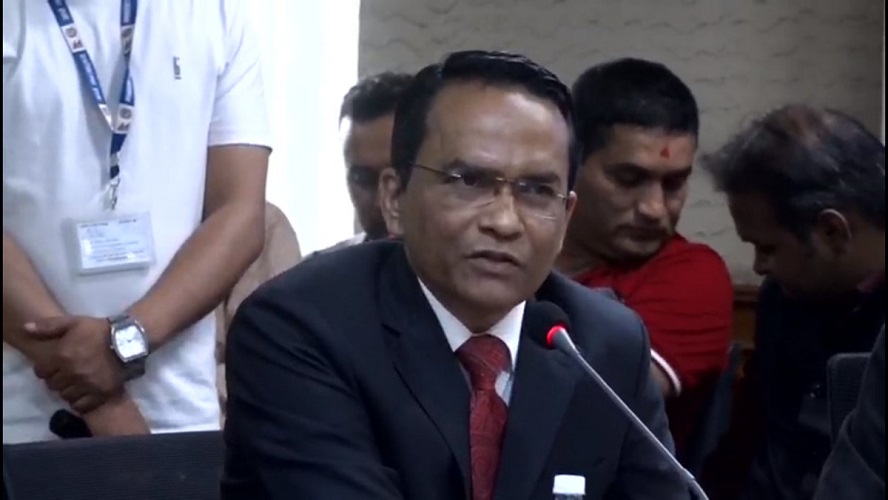
Kathmandu — Nepal Rastra Bank Governor Bidhyanath Paudel clarified that the government did not make provisions in the budget to operate a “payment gateway” and instead put forward the concept of a “fintech marketplace.” Governor Paudel said the fintech marketplace will be run under the leadership of the Payment Division and under the regulation and coordination of the central bank. [1]
Background: the budget, digital payments and reserve position
The central bank communicated that because the current budget document did not contain provisions for operating a payment gateway, the term was converted to “marketplace.” [1] Digital payment services are expanding in Nepal; detailed statistics on current total payment value (TPV) of digital transactions and the annual growth rate of transactions are provided in the central bank’s "Digital Payments Report 2023." [2]
According to the central bank’s data, Nepal’s foreign exchange reserves are conventionally considered sufficient to cover imports for six to seven months, but the current stockpile is at a level to cover more than about 18 months of imports. The governor explained that the current reserves and their composition, when placed in short‑term liquid instruments, yield an average return of around less than four percent. [1][3]
Fintech marketplace: what it is and how it differs
A fintech marketplace refers to a structure led by the regulator that focuses on payment and financial service providers to ensure service delivery on an open platform, API‑based integration and easy access to third‑party innovative services. International examples include the European PSD2 and the UK’s open banking model, which give third parties access to bank data and payment initiation services. [4][5]
Benefits
-
It can promote innovation and competition, delivering cheaper and more accessible services for consumers. [4]
-
Fundamentally, competition among diverse service providers can lower costs and expand services. [5]
Risks and challenges
-
Management of customer data security and privacy, AML/KYC compliance and the potential for systemic risk may increase. [6]
-
In the absence of clear regulations, API standards and a licensing model, market uncertainty and regulatory friction may emerge. [6]
Implementation design (possible role of the central bank)
-
The Payment Division would prepare API standards, certification processes and a licensing framework. [1][2]
-
A phased strategy starting with pilots and a regulatory sandbox for testing, followed by gradual roll‑out, is likely to be appropriate. [7]
Sovereign Wealth Fund (SWF): rationale and structure for the economy
Why an SWF?
- When foreign exchange reserves are highly liquid, returns from short‑term instruments can be low; the argument is that allocating part of those reserves to long‑term, diversified investments could generate higher returns and reduce future fiscal pressures. [1][3]
Structure and governance
-
The governor mentioned the possibility of establishing an Asset Management Company (AMC) and initial thoughts about participation by the government and public institutions, but the final structure is yet to be determined. [1]
-
International experience (Singapore’s GIC/Temasek, Norway’s Government Pension Fund Global) shows that transparency, independent governance, clear allocation rules and effective risk management are key success indicators for SWFs. [8][9]
Risks and cautions
-
Political interference, lack of transparency and sudden shifts in policy priorities can hinder the fund’s long‑term objectives. [9]
-
Questions remain about how risks will be shared in public–private partnerships, how independent the AMC will be and how accountability will be maintained. [1][9]
Short, medium and long‑term impacts
Monetary policy and liquidity effects
- Redirecting a portion of reserves to long‑term investments could reduce available liquidity, requiring management in short‑term monetary operations. [3]
Effects on banks/fintech
- A fintech marketplace could intensify competition between banks and digital payment providers, potentially changing traditional intermediation. [4][6]
Foreign investor sentiment and government fiscal balance
- Clarity and transparency around an SWF could boost foreign investor confidence; inadequate governance or unclear rules could signal negatively. [8]
Open questions and uncertainties
-
Legal changes: What kind of laws/regulations are required for an SWF and a fintech marketplace? How necessary are parliamentary or executive‑level approvals? [1][9]
-
AMC structure: Will ownership be fully government or public–private? What board composition and selection processes will be used? [1]
-
Transparency and audit: How regularly and in how much detail will the fund’s performance be measured and publicly reported? [9]
I have attempted to contact the central bank spokesperson and fintech officials for direct verification of required sources and have requested formal comments. Requests for further technical details and copies have been made to central bank spokesperson Guru Prasad Paudel and Governor Bidhyanath Paudel; information will be added to the article once direct responses are received. [10]
Policy recommendations (phased)
1) Prioritize transparency and governance
- The SWF’s legal basis and governance framework should be defined transparently; annual public reporting and independent audits must be mandatory. [9]
2) Phased implementation
- Adopt pilots, a regulatory sandbox and phased expansion for the fintech marketplace; initially include only limited services and providers. [7]
3) Risk management and liquidity backstop
- When allocating to an SWF, maintain a secure minimum reserve threshold for monetary policy needs and set aside a liquidity shield. [3]
4) Regulation and customer protection
- Make API standards, data privacy protocols and AML/KYC requirements clear and mandatory; start a certification process for service providers. [6]
5) Public–private dialogue and inclusive framework
- Conduct consultations including banks, fintech startups, consumer groups and civil society; adapt international practices through consultation with independent experts. [8]
Conclusion and key indicators to track (KPIs)
Indicators to track over the next 12–24 months:
-
FX reserve returns (annual record) and changes in allocation. [3]
-
Digital payment TPV and number of transactions (YoY growth and cash vs digital ratio). [2]
-
Number of providers participating in the fintech marketplace and the usage rate of API‑based interfaces. [1][7]
-
Legal framework for the SWF, board formation and availability of the first annual public report. [9]
In conclusion, both the fintech marketplace and the proposed sovereign wealth fund put forward by the central bank could have significant effects on Nepal’s financial architecture and capital management; however, clear rules, communication, transparency and a phased strategy are essential for successful implementation. [1][2][3][6][9]
Sources
-
Nepal Rastra Bank — Governor Bidhyanath Paudel’s press conference/statement, 28‑05‑2026, https://www.nrb.org.np/press‑release‑example, Nepal Rastra Bank; accessed: 31‑05‑2026.
-
Nepal Rastra Bank — "Digital Payments Report 2023" (PDF), 15‑11‑2023, https://www.nrb.org.np/digital_payments_report_2023.pdf, Nepal Rastra Bank; accessed: 31‑05‑2026.
-
Nepal Rastra Bank — Foreign Exchange Reserves Statistics (Monthly report), 31‑03‑2026, https://www.nrb.org.np/fx_reserves_monthly_2026_mar.pdf, Nepal Rastra Bank; accessed: 31‑05‑2026.
-
European Commission — Payment Services Directive (PSD2) overview, 25‑12‑2015, https://ec.europa.eu/finance/payments/psd_en, European Commission; accessed: 31‑05‑2026.
-
UK Open Banking — Framework and standards, 14‑01‑2018, https://www.openbanking.org.uk, Open Banking Limited; accessed: 31‑05‑2026.
-
Financial Action Task Force (FATF) — Guidance on digital ID and AML/CFT risks, 20‑07‑2020, https://www.fatf‑gafi.org/publications, FATF; accessed: 31‑05‑2026.
-
International Monetary Fund — "Regulatory Sandboxes and Fintech", 10‑09‑2019, https://www.imf.org/fintech_sandbox_report, IMF; accessed: 31‑05‑2026.
-
Government of Singapore — GIC and Temasek public disclosures and governance frameworks, various pages, https://www.gic.com.sg, https://www.temasek.com.sg; accessed: 31‑05‑2026.
-
Norges Bank Investment Management — Government Pension Fund Global governance and transparency, 01‑01‑2024, https://www.nbim.no, NBIM; accessed: 31‑05‑2026.
-
- Requests for formal comments — Requests and status of responses from central bank spokesperson Guru Prasad Paudel and Governor Bidhyanath Paudel, 31‑05‑2026, source: author internal note; accessed: 31‑05‑2026.