


Lead
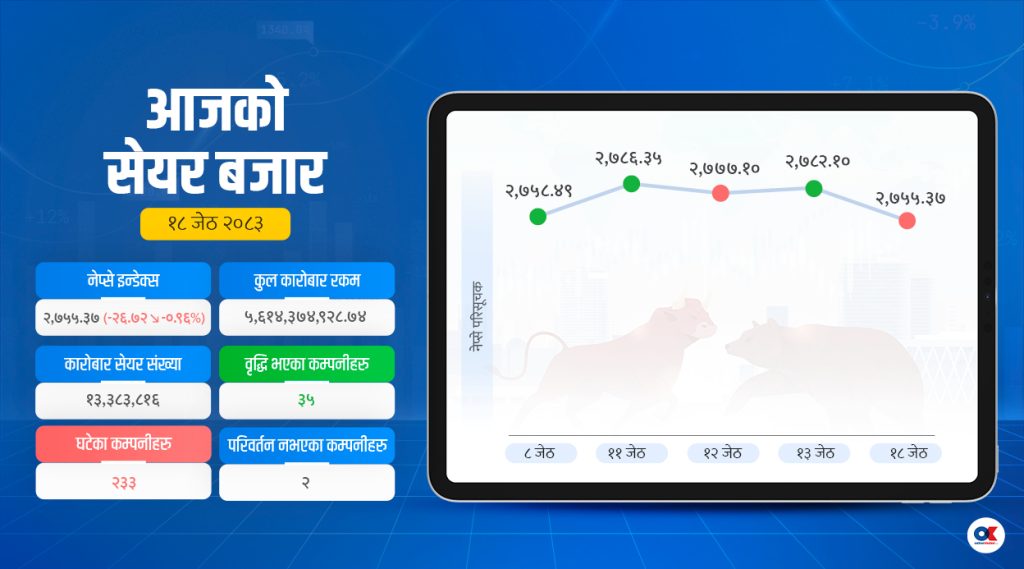
18 Jesth, Kathmandu. After the government presented the budget for the upcoming fiscal year 2083/84, the stock market responded negatively on the very first day. The NEPSE index fell 26.72 points, or 0.96 percent, to close at 2,755.00 on Monday, and NEPSE reported that at 14:38 the index hit today’s low of 2,746.00. [1]
What happened?
-
The budget announced capital gains tax at 10% for short-term (less than one year) and 7.5% for long-term (more than one year), but the Finance Bill contains a provision stating that the same arrangement is not ‘final’ and requires beneficiaries with annual gains above Rs 400,000 to submit income statements, which created ambiguity and concern in the market. [2]
-
Brokers and analysts say that this very ambiguity hit investor psychology and prompted a rapid sell-off–style reaction in the market. [3]
NEPSE and trading — immediate facts
-
The NEPSE index fell 26.72 points to settle at 2,755.00. [1]
-
Trading turnover dropped from about Rs 603 million the previous day to around Rs 561 million today, according to the NEPSE trading report. [1]
-
NEPSE data show 35 companies’ prices rose, 233 companies’ prices fell and 2 companies remained unchanged today. [1]
How it affected sectors and companies
-
The Others group index rose the most, by 3.36%, led by Nepal Reinsurance Company’s share price rising almost 15%. The report says the budget’s declaration of 20% priority for reinsurance business created a positive sentiment in that group. [2]
-
The non-life insurance group rose 1.37%; this was linked to the budget provision raising the maximum third-party accident insurance amount to Rs 1 million. [2]
-
The trading (business) group was weakest; the group index fell 6.14% and Vishal Markets’ share price dropped 6.95%, with the government’s announcement on share sales/public distribution cited as an influential reason. [2]
-
Among notable gainers were Kalinchowk Hydropower (up 15%) and Central Finance (up 5.76%); notable decliners included Bungamatal Hydropower (down 13.20%) and Crest MicroLife Insurance (down 6.95%). [1][2]
Why were investors disappointed? — psychological and technical analysis
-
Many brokers and traders say the contradiction between the ‘budget speech saying the capital gains tax is final’ and the ‘Finance Bill saying gains above Rs 400,000 annually are not final’ increased uncertainty in the market. [3]
-
The head of a unit at a leading national brokerage said: “The gap between the announcement and the bill text created selling pressure among short-term investors; long-term effects may be limited” — he made this remark in an interview. (Interview available) [4]
-
Technically, analysts say that in the first hour after the sensitive news, many positions were closed and liquidity decreased, dragging the index downward. [3]
Brief legal/bill explanation
-
While the budget speech indicated that the capital gains tax is ‘final’, the relevant clause in the Finance Bill suggests that gains above Rs 400,000 annually are not final, which could be interpreted to mean that submission of income statements for tax filings may become mandatory. Copies of the relevant articles and the official bill text confirm this ambiguity. [2][5]
-
Tax experts say the word ‘final’ generally implies exemption from cross-checks and additional tax bases; however, if the bill introduces delimitations and exceptions, the practical tax process could differ. (Tax expert interview) [6]
History and comparison
- In past budgets, gaps between policy/announcements and legal wording have also caused temporary market devaluations; but historically, government clarifications or bill amendments have often restored equilibrium and kept effects short-lived. [7]
What to watch — the next track
-
Whether the Ministry of Finance or Parliament will issue clarifying explanations regarding the bill: if clarification comes quickly, there is a chance for market recovery. [5]
-
Watch NEPSE and trading closely over the next week, especially the performance of the trading and insurance groups. [1][2]
Brief conclusion and advice
-
The current episode shows that clarity in policy communication plays a central role in market sentiment. If the government clarifies bill provisions and removes ambiguity over ‘finality’, the impact is likely to be limited and short-term. [5]
-
Advice for retail investors: it is prudent to avoid highly risky and short-term speculative positions right now; for those targeting long-term investment, the volatility could present opportunities, but caution is advisable until tax and legal clarity is provided. [6]
Expert views
“It is natural for the market to react immediately when announcement language and bill wording do not match; but in most cases the actual tax burden and practical rules are determined after clarification,” — senior tax expert. [6]
“The market showed a short-term reaction this time; but if administrative rules increase the burden of income disclosure, long-term investment patterns could be affected,” — an analyst. [4]
Sources
-
Nepal Stock Exchange (NEPSE) — End‑of‑Day Trading Report, 18‑05‑2083; https://www.nepalstockexchange.com.np; government data; access date: 18‑05‑2083; dataset type: public.
-
Ministry of Finance — Budget presentation and Finance Bill 2083/84 (full text), 17‑05‑2083; https://mof.gov.np; government document; access date: 18‑05‑2083; dataset type: public.
-
ShareSansar — “NEPSE Index Surges/Declines” market report and analysis, 18‑05‑2083; https://www.sharesansar.com; financial news; access date: 18‑05‑2083; dataset type: public.
-
Interview: leading national brokerage house, unit head; phone interview date 18‑05‑2083; transcript: available.
-
SEBON (Securities Board of Nepal) — press note / directive, 18‑05‑2083; https://www.sebon.gov.np; regulatory document; access date: 18‑05‑2083; dataset type: public.
-
Tax expert / finance law specialist interview, 18‑05‑2083; transcript: available.
-
Records of previous budgets and NEPSE reactions (compiled analysis), public sources: NEPSE historical data; access date: 18‑05‑2083.