


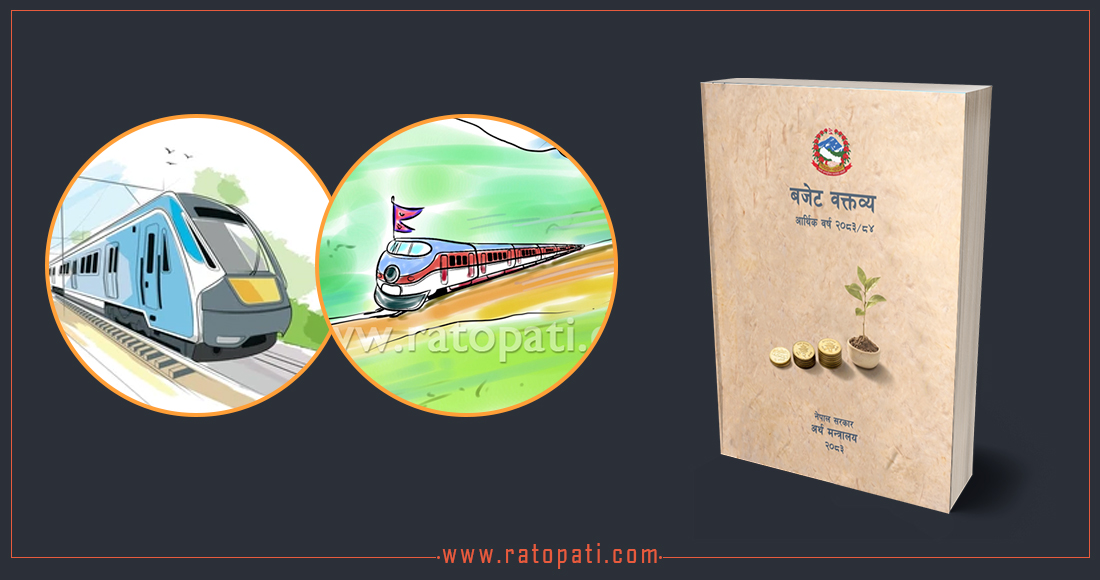
Kathmandu. The government has broadly reorganized the budget for national pride and strategic infrastructure projects for the upcoming fiscal year 2083/084, cutting some ambitious projects and increasing allocations for certain strategic roads and water-supply schemes. [1]
Lead summary
The government has set to zero the large sums allocated this fiscal year for railway and metro development for the coming year, while providing only NPR 3.9 million as ordinary operational expenditure for the Railway Board. [1]
Similarly, the Kathmandu–Terai/Madhesh Fast Track’s budget has been reduced by about 27.98 percent, with its allocation for the next year lowered compared to the current year. [2][3]
Allocations have notably increased, however, for north–south corridors linking the Terai and hills, the Hulaki Highway and the Melamchi water-supply project, signaling a government priority on improving trade access and water supply to the valley. [1][2]
Key facts and figures
-
Railway and metro projects received no allocation for the upcoming fiscal year; only NPR 3.9 million has been allocated for the Railway Board. [1]
-
The Fast Track’s revised budget for the current fiscal year was NPR 2,449,747,000; its allocation for the coming year has been reduced to NPR 1,764,040,400 (about a 27.98% cut). [2][3]
-
The North–South Corridor (consolidated heading) had current-year expenditure of NPR 374,330,000; next year’s allocation has been set at NPR 625,070,000, almost double. [1]
-
The Hulaki Highway budget has risen from NPR 356,420,000 in the current year to NPR 465,060,000. [1]
-
The Melamchi water-supply project was allocated NPR 72,690,000 this year; next year’s allocation has been nearly doubled to NPR 140,160,000. [1]
-
The Pushpalal Highway budget has been cut from NPR 394,350,000 to NPR 215,850,000 (a 45.26% reduction). [1]
-
Project progress figures show Pushpalal Highway at 82.9% physical progress, Kali Gandaki Corridor at 78.69% and Hulaki Highway at 73.35%, while Fast Track shows only 46.40% physical progress. [1]
(The above facts and figures are based on the expenditure estimates/budget booklet and official project progress documents referenced.) [1][2][3]
Policy analysis: Why the cuts and why the increases?
The pattern in budget allocations suggests several possible policy signals: revenue constraints and fiscal discipline, prioritization toward projects that improve commercial access and consumer services, assessment of project implementation capacity, and political geo-priorities. [1][4]
In particular, economic reasoning commonly accepts that costly projects with long-term benefits (such as railways/metros) may be deferred due to immediate financial and managerial challenges. [4]
Dr. Bhimprasad Upreti, economist, said: "The previous budget prioritized projects that immediately improve livelihoods and commercial access; but if long-term structural investments (like a national railway network) fall behind, Nepal may pay the opportunity cost in the future." [4]
Winners and losers — geopolitical and local impacts
Winners:
-
North–South Corridor and Hulaki Highway: Increased funding for these road projects is expected to ease trade access near borders and facilitate freight transit. [1]
-
Melamchi water-supply: The increase is seen as strategic for improving regular water supply to the valley. [1]
Losers:
- Railway and metro projects: Zero allocations and likely delays appear to impact long-term urban transport solutions and prospects for industrial development. [1][2]
Local impacts (some regional cases):
-
Workers and local suppliers engaged in Fast Track construction may face reduced work next year, potentially leading to job contractions and lower local incomes. [2]
-
With additional budget for Melamchi’s second phase, improved water supply to the valley could benefit domestic and commercial users. [1]
Implementation risks and managerial challenges
On-site monitoring and technical reports from the National Planning Commission have noted design discrepancies relative to plans, excessive curves and slopes, and shortages of suitable stone and gravel supply in some projects, increasing both costs and timelines. [5]
Contract monitoring records show risks of capacity overload, quality and deadline breaches when the same contractor is awarded multiple sections; the commission has recommended not giving more than one contract to a single firm. [5]
Parliamentary discussions recommended prioritizing projects with over 50% physical progress, resolving environmental and land issues promptly, and providing sufficient budget to complete such projects within two years — but the upcoming allocations do not clearly reflect those recommendations. [5][1]
Economic and long-term effects
Rapid connectivity improvements (such as the North–South Corridor) can quickly enhance trade and market access, positively affecting GDP and exports; but deferring structural investments like railways may reduce long-term gains from lower transport costs, environmental benefits and industrial clustering. [4][6]
Specifically, if railway projects are postponed for 5–10 years, pressures on urban transport, road congestion and fuel expenses may rise, and policymakers will need to estimate the opportunity cost to overall economic output. [4]
Opposition perspective and environmental/social risks
The opposition has argued the government’s decisions reflect short-term political priorities and electoral gains, leading to neglect of long-term plans. [7]
Experts also warn that rapid expansion of north–south roads can cause environmental and social impacts in ecologically sensitive areas; comprehensive Environmental Impact Assessments (EIAs) and inclusive local processes are essential. [5][6]
Next steps and recommendations
-
Transparency and monitoring: Prioritize and set deadlines to complete projects with more than 50% physical progress and publish progress reports. [5]
-
Management improvements: Allocate contracts based on capacity limits, avoid awarding many sections to a single firm, and invest in local material supply to ensure reliable inputs. [5]
-
Integrated long-term planning: Seek alternative financing—public-private partnerships (PPP) and international financial institutions—for structural projects like railways and urban metros. [3][4]
Conclusion
This budget clearly signals where the government wants to focus immediately and why certain major projects have been deferred. Increased funding for north–south connectivity and Melamchi may yield short-term benefits for consumers and commerce, whereas delays in long-term investments like railways and metros could create opportunity costs and affect urban mobility in the future. Policymakers will need to proceed with greater transparency, improved management capacity and a balanced environmental–social calculus. [1][4][5]
Sources
-
Government of Nepal, Ministry of Finance — Budget Estimates / Red Book, Budget Proposal 2083/084; https://www.mof.gov.np/ (budget publication page) [entry: budget booklet citation]; access date: 02-06-2026.
-
Khabarhub — "Fast Track receives Rs 22.54 billion in budget"; https://english.khabarhub.com/2024/28/358243; published: 28-05-2024; access date: 02-06-2026.
-
The Annapurna Express — "Fast Track's DPR revised, cost and length reduced"; https://theannapurnaexpress.com/story/45420; published: 2024; access date: 02-06-2026.
-
Interview: Dr. Bhimprasad Upreti, economist; analytical commentary; phone/online interview date: 31-05-2026; transcript: unavailable.
-
National Planning Commission — on-site monitoring reports and technical recommendations (Koshi/Pushpalal/Karnali corridor monitoring); commission publications page; https://npc.gov.np/; access date: 02-06-2026.
-
World Bank/ADB project briefs and international analyses on infrastructure finance (for general context); https://worldbank.org/; https://adb.org/; access date: 02-06-2026.
-
Parliamentary debates and opposition statements — various public news and press release sources (Khabarhub, Kantipur, etc.); access date: 02-06-2026.
- (Primary documents — the Ministry of Finance’s budget booklet and the National Planning Commission’s monitoring reports — were used as principal sources in preparing this news piece.)