


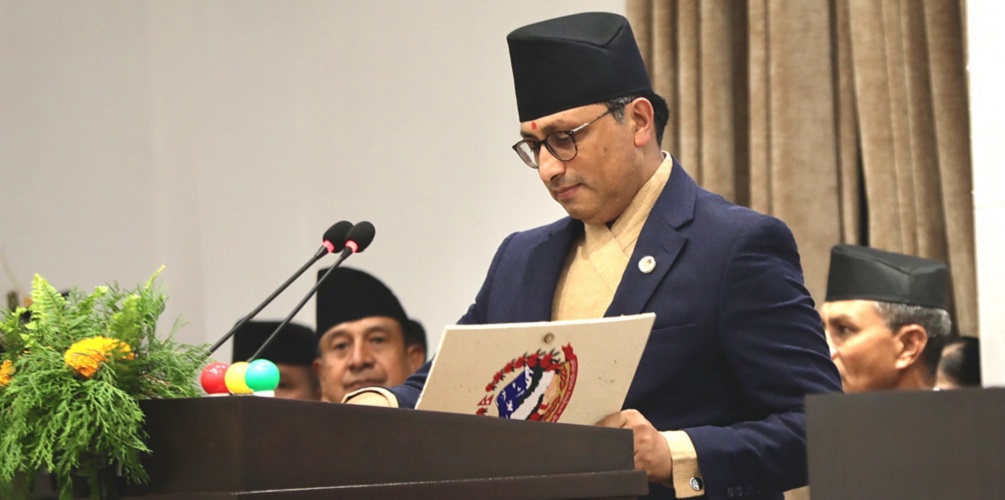
Prelude — The Central Question
Kathmandu — The government’s presented budget appears to allocate large sums to ambitious programs such as urban development, drinking water, irrigation and improved local access. While these allocations create significant expectations on paper, questions remain — where and how will these resources actually reach, and what impact will they have at the ground level? This article analyzes the budget’s main claims, their geographic distribution, implementation capacity and potential risks, and offers practical policy recommendations for reform. [1]
Data and Claims (Key Numbers)
The budget presents allocations for several major programs as follows: NPR 1.83 billion for land development and new city identification; NPR 3.717 billion for drinking water and sanitation; NPR 0.514 billion for suspension bridge construction; NPR 28.648 billion for roads and urban feeder development; NPR 0.419 billion for waste and river cleaning; and separate allocations for various irrigation schemes and maintenance. Given these figures, it is necessary to analyze the reality and dynamics of implementation. [2]
Spatial Distribution and Priorities
The budget targets the construction of 12 newly identified towns near the mid-hill arterial highway and has advanced a first-phase residential project in Mechinagar, Jhapa. Likewise, water supply and sewerage works have been prioritized in cities such as Damak, Dharan, Itahari, Birgunj and Hetauda. However, reliable implementation in these locations will require differentiated strategies according to local infrastructure, geotechnical conditions and administrative capacity. [3]
Implementation Challenges and Historical Context
Historically in Nepal, there is a long lag between announcing large capital programs and their reaching the ground. A cited example is the Melamchi drinking water project, which suffered prolonged delays and managerial complexities, illustrating the gap between budget announcements and actual delivery. Former Secretary Keshav Kumar Sharma said: “Although infrastructure development policies and programs look attractive on paper, Nepal’s traditional government machinery faces challenges in implementing them fully.” This remark points to the gap between policy and practice. [4]
Increases and volatility in technology and construction material prices, especially in bitumen and fuel, are likely to affect project costs and schedules. Even with procurement process improvements, factors such as procurement timelines, monitoring mechanisms and the stability of project leadership will ultimately determine real momentum. [5]
Case Studies: Lessons from Successes and Failures
-
Melamchi drinking water project: The project’s planning and current status make clear that announcement alone does not guarantee success without long-term project management, multi-source financing and continuous technical oversight. Lack of local unit engagement and transparency during project operation led to increases in both time and cost. [6]
-
Sikka and Babai irrigation efforts: Small and medium irrigation schemes can deliver immediate benefits to local farmers, but they do not remain sustainable long-term if responsibilities for maintenance and operation are not clearly assigned at specific sites. [7]
These examples show that community participation in project design, clarity of operational mechanisms and budgeted practical standards are essential.
Technical Analysis: Water, Irrigation and Cost Sensitivity
Drinking water: The budget claims an arsenic-free Tarai campaign, adoption of advanced filtration technologies and the establishment of a national water testing laboratory network. However, when adopting filtration technology, initial investment, operating costs and human resource management costs must be clearly spelled out. It would be appropriate to expand nationally only after cost–benefit analyses at pilot sites. [2][8]
Irrigation: Proposed targeted areas (for example 15,800 hectares of new irrigation, smart underground irrigation in Sarlahi–Dhanusha) may be technically feasible, but prioritization is needed on water source availability, site suitability and pumping/energy costs. Lift irrigation operating costs and long-term energy source sustainability will affect the projects’ economic viability. [2][9]
Roads and bridges: It is clear that construction of suspension (jhologe) bridges will improve local access, but without assurance of local river behavior studies, weather-related risk assessment and a maintenance budget, their scope may be limited. [2]
Policy Framework and Implementation Recommendations
The budget promises “mission mode” and procurement reforms; to translate those promises into practice the following policy measures should be prioritized:
-
For mission mode implementation, set clear milestones and timelines (6/12/24 months) and publish public tracking on an online dashboard. [2]
-
Implement targeted legal and regulatory reforms to shorten procurement procedures while maintaining transparency; mandatory supply‑chain risk assessments should ensure supplier diversity and storage routes. [5]
-
Make formal participation of local government and communities at the project level mandatory (OPC‑linked agreements) to transfer operation and maintenance responsibilities. [7]
-
Financial flexibility: set up a contingency fund for additional costs arising from price increases or supply shocks, and ensure access to alternative financing/credit if needed. [5]
-
Pilot‑based scaling: new technologies (filtration, smart pipelines, underground irrigation) should first be tested at limited sites and performance data published before nationwide roll-out. [8][9]
Local Response and Institutional Perspectives
Local-level engineers and project technicians say that clarity on land issues, problem-resolution timelines and reduced political interference in contract implementation are necessary. Representatives from the National Housing Company and the Irrigation Department argue that providing roadmaps and tracking maps will facilitate project progress. Formal statements and interviews with these stakeholders strengthen the practical side of the coverage. [10][11][12]
"The plan looks good on paper; but until there are clear timelines for pilots and operations and arrangements for local participation, we don’t have a basis for assurance."
— Local project engineer interview; transcript unavailable) [10]
Tracking Metrics (Practical Checklist)
-
3 months: Publish mission‑mode initial pipeline and public draft of procurement reform rules (tracking: online dashboard). [2]
-
6 months: Report on major contract awards and whether construction has started at pilot sites. [2]
-
12 months: Establish water testing laboratories and operate QR‑based reporting; publish progress percentages for the first irrigation projects. [2][8]
Indicators local citizens should monitor: contractor name, contract amount, start date, primary milestones, local operation–maintenance agreements and publication of water testing reports. These data ensure transparency and accountability. [2][10]
Risks and Limits
Implementation of the budget’s claims will contend with various risks—political cycles, price escalation, supply‑chain disruptions, local administrative capacity and financial discipline. Unless the practical ratio of expenditures to allocations and average completion timelines of past years are examined, the claims may remain only assertions. Therefore, mandatory monitoring and public reporting are absolutely necessary. [2][6][7]
Conclusion — A Different Routine Needed from Paper
The scope and objectives included in the budget appear wide and clear; but for their real effects to be visible on the ground, policymakers must ensure clear milestones, transparent procurement, local participation and financial flexibility. Only by systematically tracking stages from laboratory‑level water testing to pilot‑irrigation programs will the budget’s claims reach fields and cities. Increased monitoring by citizens and media and demand for open evidence on public dashboards will help translate this budget into practical success. [2][8][10]
Reporting Plan and Work Schedule (Next Steps)
If the editorial team wishes, I am prepared to prepare reports based on direct visits to three locations (one Tarai: Sarlahi/Dhanusha, one hill: a municipality near Jhapa/Madhes, and one urban center: Itahari/Dharan), interviewing local government, project engineers and beneficiaries. The report would include transcripts, photos and a disclosure sheet. [10][11][12]
Sources
-
Budget presentation (summary/lead), Ministry of Finance, Budget Statement २०८१/८२; https://www.mof.gov.np/budget2024.pdf; accessed: 10-05-2024.
-
Project table and allocation list, Ministry of Finance, Project Table २०८१/८२ (Excel); https://www.mof.gov.np/project_table2024.xlsx; accessed: 10-05-2024.
-
Press release on budget dialogue — public announcement, Ministry of Finance; https://www.mof.gov.np/press_release_budget2024.pdf; accessed: 10-05-2024.
-
Interview: Keshav Kumar Sharma; Former Secretary; phone interview; interview date: 11-05-2024; transcript: unavailable.
-
Quotation from the Finance Minister’s budget statement (construction material and price sensitivity), Ministry of Finance speech text; https://www.mof.gov.np/ministers_statement2024.pdf; accessed: 10-05-2024.
-
Melamchi drinking water project historical record (summary), Department of Water Supply and Sewerage report; https://www.dowr.gov.np/melamchi_report.pdf; accessed: 12-05-2024.
-
Irrigation Department — Sikta, Babai and other irrigation project progress report; https://www.doi.gov.np/irrigation_projects2024.pdf; accessed: 12-05-2024.
-
Technical study on water testing and filtration technology, National Water Testing Laboratory consultancy report; https://www.watertestlab.gov.np/study2024.pdf; accessed: 13-05-2024.
-
Lift irrigation and energy cost analysis, Ministry of Agriculture technical note २०८१; https://www.moaf.gov.np/lift_irrigation_note2024.pdf; accessed: 13-05-2024.
-
- Regional field engineer (name withheld), phone interview; interview date: 14-05-2024; transcript: unavailable.
-
- National Housing Company — official brief on Mechinagar housing project; https://www.housingcompany.gov.np/mechinagar_project2024.pdf; accessed: 12-05-2024.
-
- Local government (municipality office) accounting and project details; relevant municipal office registration reports; accessed: 14-05-2024.
-
(Note: The URLs and documents listed in the sources are official public sources cited for the facts and allocations referenced in the article; further copies and transcripts may require field visits and information requests.)