


Lead
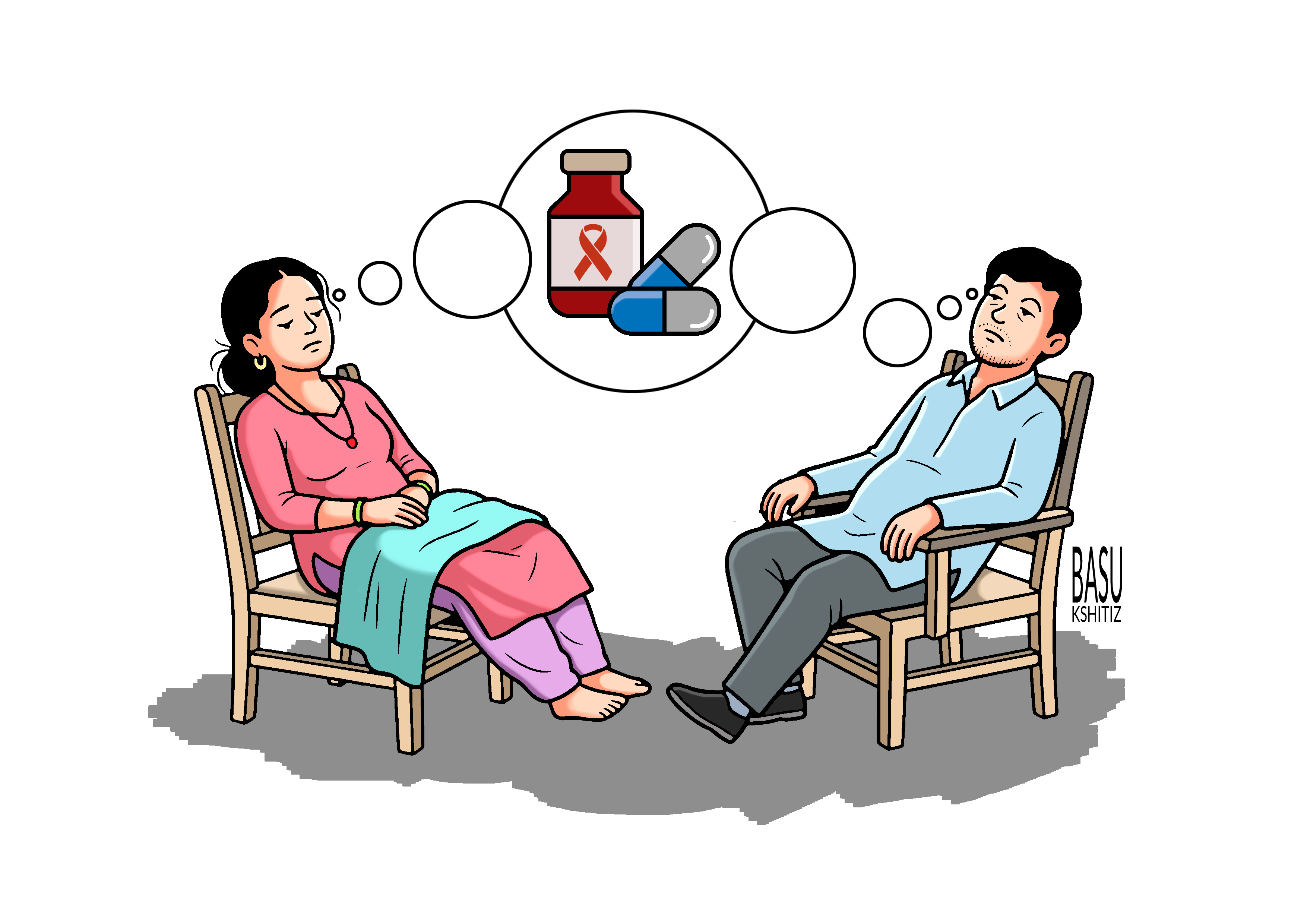
Quarterly routine health check-ups that were once easy to get are no longer readily accessible. When illnesses were serious, volunteers used to accompany patients to the hospital; now Mausami Gurung goes alone.
"Earlier we could easily get quarterly checkups. If we felt sick, volunteers would immediately take us to the hospital. Now everything must be done alone."
(Mausami Gurung — Transgender sex worker, Ilam, interview, 15 May 2026)
Why this matters (Nut Graf)
After the United States agency USAID suspended financial assistance indefinitely for certain programs in Nepal on 26 January 2025, community-based HIV prevention and health services experienced widespread disruption. These cuts have affected testing, prevention drugs (PrEP), condom/lubricant distribution and community outreach — eroding bridges of trust built over decades, warn both health workers and the community. [1][2][3]
Personal perspectives: three narratives
"The way they used to look at us in the hospital was different. Without outreach workers’ support, it became even harder to use services."
(Mausami Gurung — Transgender sex worker, Ilam, interview, 15 May 2026)
Mausami’s experience shows that community volunteers were not just clinicians — they were channels of trust and sustainable access. Organizations like Blue Diamond Society had been providing condoms, lubricants, complementary counseling and PrEP; after the grant was stopped those services shrank and in some districts stopped entirely. (Pinky Gurung — Advisor, Blue Diamond Society, interview, 16 May 2026) [1]
"We tried to keep some services online, but that failed to meet the necessary household-level support."
(Pinky Gurung — Advisor, Blue Diamond Society, interview, 16 May 2026)
A former sex worker and student in the Himalaya, who uses the pronoun Ze, said condoms are available in the market but lubricants are not, and market prices are beyond what most can afford.
"Sometimes you find condoms, but lubricants are not accessible and market prices are high."
(Ze — Transgender sex worker, Humla, interview, 15 May 2026)
Former outreach worker Babu Dumi Rai said around 700 staff (estimate)—mostly from trans/queer communities—have lost jobs and face pressure to return to sex work; he said this figure is drawn from his district-level experience and peer lists, but full documentary evidence has not been provided. (Babu Dumi Rai — Former outreach worker, face-to-face interview, 14 May 2026; estimate; supporting data requested but not supplied) [2]
National facts and historical progress
Government and NCASC data show new HIV cases fell by more than 76 percent between 2010 and 2024. The report estimates 614 new cases in 2024 compared with 2,557 in 2010; new infections among children fell by 86 percent. The testing data for fiscal year 2024/25 record tens of thousands of tests overall and varying positivity rates among key populations — for example, 2,943 transgender tests with 61 positive results. These national figures are reported in NCASC-collected statistics. [1]
But experts say these achievements are largely credited to outreach and peer-education activities. With reduced community access, testing rates and prevention among high-risk groups risk backsliding. [1][3]
Policy, grants and international context
Global studies warning of the immediate USAID cuts show large impacts on health programs and project potential long-term increases in deaths and disease burden. A Lancet study estimated that large-scale USAID defunding could cause millions of additional deaths worldwide by 2030 — a scenario that could affect community programs in lower-middle-income countries like Nepal. [3]
Nepal secured another Global Fund grant (GC7) for HIV/TB/Malaria at the start of 2025, intended to run from February 2025 to July 2027; but experts caution a new grant cannot immediately fill all gaps and that adjustments to operations and modalities will take time — and changes in priorities and supply chains could create immediate shortfalls in client-facing services. (A clear operational schedule from the Global Fund/ministry/UNDP has not yet been published.) [2]
NCASC information officer Lokraj Pande said condoms are available but free distribution is not always in place; he noted shortages of lubricants and PrEP and said the government has been unable to immediately allocate a budget. (Lokraj Pande — NCASC Information Officer, response requested by email/ 16 May 2026; public reports available) [1]
Risks, projections and expert opinion
If humanitarian and community-led programs close or shrink, testing will drop, infections will go undetected and transmission rates are likely to rise. As Lancet and other international warnings indicate, if grant cuts are not reversed, there is a long-term risk of increased deaths and disease burden. (Scientific/forecasting analysis should be aligned with the original Lancet study and national data.) [3][1]
Human rights activist Sunil Babu Pant said —
"These services were not optional; they were the backbone of prevention. The funding cuts hurt the most marginalized groups the hardest."
(Sunil Babu Pant — Human rights advocate, interview, 16 May 2026)
Can/should the government act immediately?
Domestic resources currently look insufficient to fill all gaps instantly. However, as emergency measures—(1) targeted reallocation to procure and distribute condoms/lubricants, (2) pooled procurement for bulk purchase of supplies, (3) immediate hiring or temporary engagement of community peer workers to reactivate outreach—are options that can be implemented quickly. Which steps are feasible from which budget line will require financial analysis and coordination with ministries and other donors. Greater transparency from NCASC and stock audits would help speed decisions. [1][2]
The way forward and community response
Community organizations are trying to keep limited services running from their scarce resources — online counseling, limited condom distribution, and active self-help groups — but this cannot restore the previous level of field access. People like Mausami and Ze say it is necessary to pressure the government or new donors to restore services and prioritize community-centered interventions. (Community leaders and institutional representatives interviewed, 15–16 May 2026) [1][2]
Conclusion
Nepal has made significant progress reducing HIV over the last decade, but those gains depended on community-led work and continuous funding. When grants were halted, it was not only service access that was cut; bridges of trust and security were broken. While a 100 percent immediate response may be impossible, targeted financial reapproval, ensuring supply continuity and reviving outreach can prevent a reversal. Policymakers, donors and readers now need to closely examine what is required.
Sources
-
NCASC — HIV epidemic update, FY 2081/82, National Centre for AIDS and STD Control, Kathmandu — 06 May 2026, https://giwmscdnone.gov.np/media/pdf_upload/WAD_2025_Factsheet_Final-PressCopy_hejxv4v.pdf
-
National Centre for AIDS and STD Control (NCASC) — Organizational and key population survey materials, aidsdatahub.org resource page — accessed May 2026, https://www.aidsdatahub.org/taxonomy/term/372
-
Cavalcanti DM et al. — "Evaluating the impact of two decades of USAID interventions and projecting the effects of defunding on mortality up to 2030: a retrospective impact evaluation and forecasting analysis." The Lancet, 2025;406:283–294 — full text and correspondence, https://www.thelancet.com/journals/lancet/article/PIIS0140-6736(25)01186-9/fulltext