


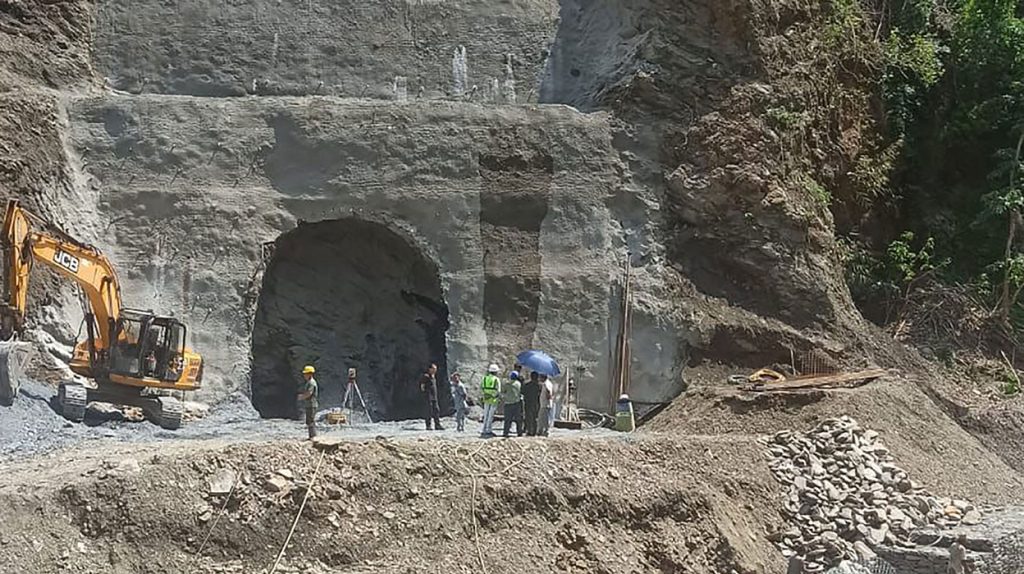
30th Baishakh, Damouli (Tanahun) – The construction of the entrance tunnel for the 126-megawatt Lower Seti Hydropower Project has commenced in Devghat Rural Municipality-4, Tanahun. Tanahun Hydropower Limited, fully owned by the Nepal Electricity Authority, has signed a contract with R.K. Hydro Engineering and Associates Pvt. Ltd. of Kathmandu for the tunnel construction.
Following the contract agreement concluded on 7th Falgun, 2080 (Nepali calendar), the project faced some delays due to the approval process related to the use of explosive materials, as informed by project chief Harikumar Shrestha. He stated that construction has now begun after obtaining the necessary approvals.
According to Shrestha, the entrance tunnel will be crucial for the main structure of the project, requiring essential geological studies, exploration, and access routes. The Lower Seti Hydropower Project is a semi-reservoir type project characterized by a picking run-off the river. He mentioned that the project aims to produce an annual electricity output of 520.78 million units.
He further explained that the dam for the project will be constructed on the Seti River near Sarangghat, under Bandipur Rural Municipality in Tanahun district. The dam will have a height of 32 meters, and a reservoir approximately 12.7 kilometers long will be created. The stored water will be channeled through a 6.75-kilometer long tunnel to the semi-underground power station located in Devghat Rural Municipality-4, Gaighat.
According to Shrestha, the detailed project report has been prepared with the grant assistance of the Asian Development Bank. He noted that the estimated total cost of the project is 227 million US dollars, and the conceptual decision to finance the project with 30 percent equity and 70 percent loan has already been made by the Nepal Electricity Authority.
Shrestha informed that the process of acquiring approximately 146 ropanis of land for the construction of the power station and staff housing has begun. He stated that this process was initiated after the necessary budget allocation from the Nepal Electricity Authority.
Once the project is operational, it is expected to produce a minimum of 126 megawatts of electricity for at least six hours daily during the winter season, Shrestha said. He emphasized that the Lower Seti Project is a significant "cascade" project for the optimal utilization of water flowing from the reservoir of the under-construction Tanahun Hydropower Project in the upper region. He pointed out the need for the government to prioritize sufficient budget management for such projects.
According to Shrestha, since the transmission lines of the Tanahun Hydropower Project can be utilized, there is no need to construct additional transmission infrastructure. He also mentioned that the project is located close to major load centers like Kathmandu and Bharatpur, making it cost-effective and commercially viable.
Shrestha stated that the grid connection agreement has been completed, and the electricity purchase agreement is in process. He highlighted that constructing a permanent bridge over the Trishuli River is essential to ensure access to the power station and staff housing area located in Devghat Rural Municipality-4. The estimated cost for this bridge construction is around NPR 370 million, and a multi-year budget arrangement will be necessary.
He also mentioned that the environmental impact assessment has been submitted for final approval to the Ministry of Forests, and efforts are underway for financial assistance from the Japan International Cooperation Agency. Additionally, he noted that the project has been placed in the pipeline for implementation by the year 2027 with the ADB.
RASS (Rashtriya Samachar Samiti) is the official news agency of Nepal.