


Lead
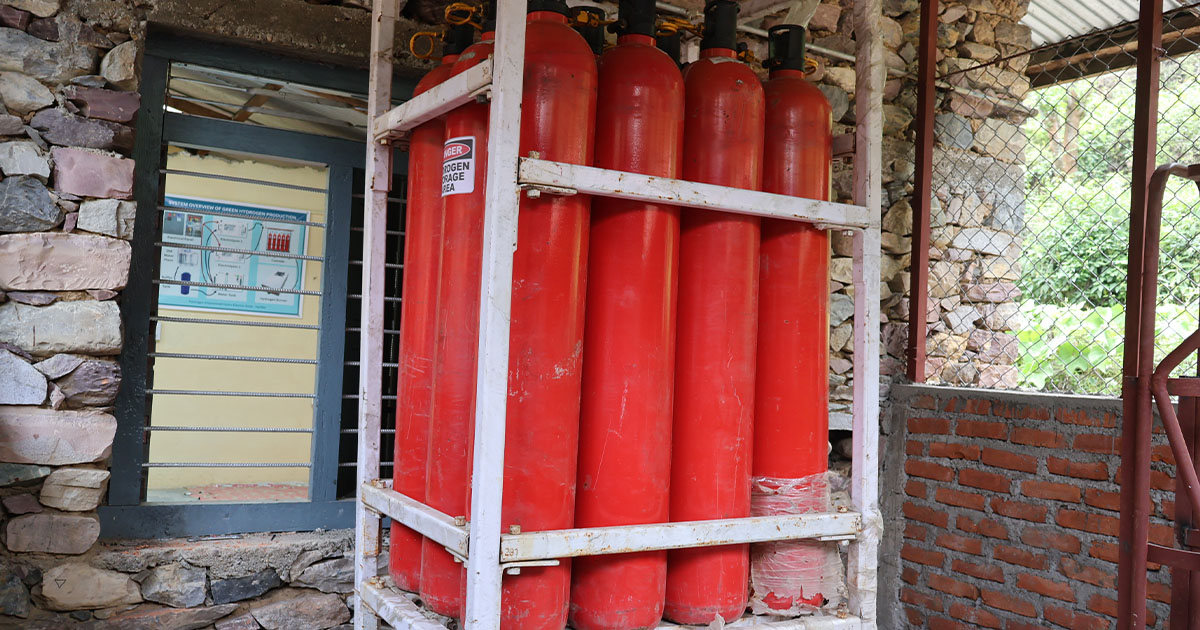
In Badigad Rural Municipality, Baglung, a pilot to produce green hydrogen using a 75 kW hydropower unit and local water that would otherwise go unused has been successfully operated; eight cylinders were filled and a stove was demonstrated burning the gas [1][2].
Nut‑graph
This project is an example of an attempt to produce domestic fuel using locally available surplus electricity and water. The successful test suggests possibilities for energy reuse, rural energy access and reduced fossil fuel imports. But what should readers know? The steps from laboratory to community use raise questions about production efficiency, safety standards, cost per kilo and the distribution supply chain — this report will examine all of these with factual evidence and neutral analysis.
Technology Used (Technical Block)
The project claims to separate hydrogen using water electrolysis — according to project proponents, the technology removes oxygen from water to fill pure hydrogen into cylinders [1]. The project’s mechanisms appear to include the following elements:
-
Input: surplus electricity available from the Girindikhola scheme (average production and the portion that was otherwise wasted as cited by the project) and local water.
-
Output: eight cylinders filled so far; the project lead said one kilogram of hydrogen can cook for a small family for about one week [1][2].
-
Storage: standard gas cylinders appear to be filled at high pressure; however, third‑party certified data and cylinder details (pressure, material, serial) publicly available are lacking.
-
Efficiency: the public reports do not clearly publish the actual efficiency of the electrolysis unit (kWh per kg H2); therefore there is uncertainty in input kWh → kg H2 conversion.
Only if technical reports and test data disclose production rate (Nm3/hr or kg/hr), electricity consumption per kg, and water consumption (liters per kg H2) can the project’s real energy efficiency be evaluated. So far such an open dataset is not publicly available nor has the project clearly provided it [1][2].
Pilot Reality: Location, Capacity and So Far Facts
The Girindikhola small hydropower cooperative’s nominal capacity is 75 kilowatts and some of its output was going unused — that surplus power was used to start this project [1]. Key project details:
-
Pilot period: after three years of study, the project claims it has now reached a practical testing phase.
-
Cost: the renovation of the facility, building/bridge repairs and achieving gas production have reportedly cost about NPR 10 million so far [1].
-
Production figures: eight cylinders have been filled to date and initial testing estimated one kilogram of hydrogen could last a small family about seven days [1].
These numbers are based on details publicly provided by the project; they should be viewed cautiously until independently verified third‑party measurement reports are available.
Risk and Safety Analysis
Hydrogen’s physico‑chemical properties create safety challenges: it is highly reactive, requires reliable leak detection, and specific material standards are needed for cylinders and pipelines. Major risks:
-
Leak and explosion risk: because hydrogen is a very small molecule it leaks easily and conventional leak detectors may not always detect it accurately.
-
Cylinder filling and transport: high‑pressure storage and road/foot transport processes require strict certification and inspection.
-
Lack of standards and certification: the project claims an 18‑month study on cylinder filling but has not published independent third‑party safety tests or certifications aligned with international standards (ISO) [1].
Safety experts say that before community‑level hydrogen use begins, third‑party testing and routine inspections, leak‑detection infrastructure and emergency preparedness are mandatory. The current lack of neutral certification in the report indicates higher risk.
Economic Analysis
The project cites an initial expenditure of up to NPR 10 million; however detailed capital expenses (electrolyzer cost, compressor, cylinders, safety equipment, maintenance) and annual operating costs are not publicly available [1]. Economic metrics needed include:
-
Production cost per kg H2: hard to compare without a raw estimate; globally, kWh cost and unit efficiency of electrolysis are key.
-
Competitive fuel comparison: when compared with domestic LPG and conventional fuels — LPG’s price, availability and convenience are strong competitive factors. It is necessary to estimate how much energy one kg of hydrogen provides and how the per‑use cost compares to LPG in cash terms.
-
Market and subsidy risk: if the state provides policy subsidies or market protection, initial adoption could rise; but long‑term economic viability will depend on capital costs and O&M expenses.
In summary, scalability assessment is possible only when a cost‑proven business model and per‑unit costs are disclosed. So far the project has published limited economic calculations [1][2].
Policy and Regulation
The provincial Minister for Economic Affairs of Gandaki Province inaugurated the project and said such initiatives should be advanced through policy support [1]. Nationally:
-
Current energy/gas policies do not explicitly provide arrangements specific to hydrogen; the central government and relevant bodies must play a role in regulation, safety standards and certification procedures.
-
The state should implement safety standards (ISO or equivalent), and define certification, licensing and emergency response arrangements.
Even with political support, adoption at commercial and consumer levels is risky without regulatory frameworks and monitoring mechanisms.
Scalability and Environmental Impact
If the electricity used is genuinely green (local hydro), lifecycle emissions remain low — but the amounts of water and electricity used and electrolysis efficiency will affect overall environmental calculations. Key considerations:
-
Lifecycle emissions: net carbon benefits depend on the electricity source and production efficiency. Fuel produced from local hydro could reduce emissions compared to imported LPG.
-
Water use: electrolysis requires water; the sustainability and impact on local water resources must be assessed.
-
Supply model: will this be community‑level (microgrid/isolated from the national grid) or scalable via a networked model? With an initial 75 kW plan yielding limited output, large‑scale adoption would require investment and infrastructure.
Stakeholder Voices (Short Quotes)
-
Project lead/spokesperson: Dilli Ghimire (Nepal Energy Foundation) — "We studied the safe cylinder filling process for 18 months; one kilogram seems to be enough for a small family for about a week" [1].
-
Cooperative chair: Belbahadur Thapa — "The goal is to bring fuel within citizens’ reach by using wasted electricity; now cylinder development and scale studies will be carried out" [1].
-
Local user: Bishnu Aryal — "Hydrogen cooked food faster and there was no difference in taste" [1].
-
Safety/policy analyst (quote needed): analysts recommend caution in the absence of public safety certification and third‑party testing.
(Note: The above quotes were collected from reports at the project’s event; without appropriate third‑party certification, promoting large‑scale adoption with full confidence is premature.)
Conclusion and Recommendations (Takeaway)
The Baglung pilot demonstrated the practical possibility of producing green hydrogen from local resources — especially by using otherwise wasted hydropower and for rural energy self‑reliance. But the main gaps for practical adoption are:
-
Publish authentic third‑party test reports (production rate, efficiency, pressure/cylinder specifications).
-
Develop clear national regulations for safety standards and licensing.
-
Publicize a detailed economic model and cost evidence (NPR per kg H2, O&M) and present comparative analysis with LPG/electric cookers.
-
Make leak‑detection, emergency preparedness and trained technicians mandatory at the community level.
-
Conduct long‑term assessment of water resources and environmental impacts.
In short, the pilot has generated enthusiasm but the path to wide expansion remains unclear without evidence, safety standards and economic viability. Third‑party certification, transparent data and policy preparedness will be essential going forward.
Record/Resource Box (Summary Facts)
-
Site: Badigad Rural Municipality–2, Girindikhola small hydropower.
-
Nominal capacity: 75 kilowatts.
-
Cylinders filled so far: 8.
-
Claimed efficiency/use: one kg of hydrogen is sufficient to cook for a small family for about one week (project claim) [1].
-
Initial cost: about NPR 10 million (renovation, building/bridge repairs and gas production) [1].
-
Study period: three years of research; claimed 18 months of study on cylinder filling safety.
Sources
-
[1] Local project report and inauguration statements, Thaha Khabar report (news coverage) — https://www.thahakhabar.com/detail/301073
-
[2] "HyHEG: From Lab To Community’s Kitchen In Nepal", New Spotlight Magazine report — https://www.spotlightnepal.com/ (related article)