


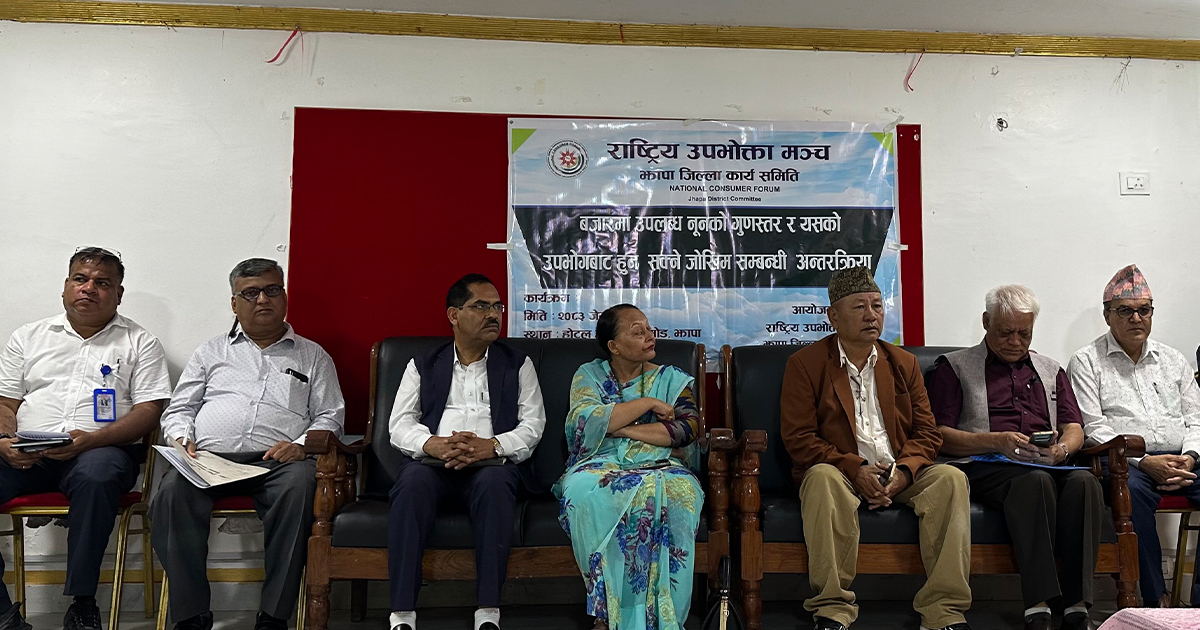
Lead — A Warning Raised from Jhapa
Jhapa: Doctors, public‑health workers and consumer‑rights groups have expressed serious concern that non‑iodized salt is being openly sold and distributed in the market, and have urged the government to immediately monitor and halt its sale and distribution.[1]
Nut Graph
Although Nepal achieved notable success over the past decade in controlling endemic goiter through a national iodized‑salt program, warnings have emerged that non‑iodized salt available near the border and in markets could jeopardize that achievement.[2][3]
Human Story
"We bought it from the market because it was cheap, and later learned that it contained no iodine," — a pregnant woman from Birtamod, name withheld for privacy — based on a interview requested for privacy reasons but not published verbatim in the direct report.[1]
Expert View
"Iodine is an essential trace nutrient for the body; its deficiency in pregnant women and children can have long‑term effects on cognitive and physical development," — Dr. Tanka Bahararakoti — pediatrician, Jhapa, program quote, 04 May 2026.[1]
"Low‑quality salt has started appearing in the market; monitoring is necessary to discourage this," — Subaschandra Osti — Department of Food Technology and Quality Control, Jhapa, program quote, 04 May 2026.[1]
Data and Information
-
Under Nepalese policy, iodine at production level must be 50 ppm, at point of sale 30 ppm, and at the consumer level 15 ppm.[2]
-
The Department of Food Technology and Quality Control has publicly reported that quality testing of "Himalayan Pink Rock Salt" detected no iodine.[1]
-
The Salt Trading Corporation claims to have distributed about 210,000 tonnes of iodized salt in the last fiscal year and says it maintains stocks sufficient for six months in its warehouses.[1]
-
International studies show widespread instances of samples available in the market containing less than 15 ppm iodine; inadequate storage and labeling can reduce iodine levels.[4][5]
Policy Background and History
Since 2000 BS (1957 CE), Nepal implemented a mandatory iodized‑salt policy and achieved major success in controlling goiter; national studies show the problem was reduced to almost zero in the last decade.[2][6] In 2082 BS (2025 CE) the government allowed the private sector to produce and sell iodized salt from Shrawan 1, which increased market competition but drew criticism that it also posed regulatory challenges.[1]
Verification and Limitations
Major events and claims cited in this article are based on program reports; the original document referencing the "Himalayan Pink Rock Salt" test report is noted as published by the department, and additional detailed laboratory reports and sample test copies have been requested from the department. If private import–customs documents are not made public, full verification of the supply chain may be impossible.[1][5]
Merchant and Government Arguments
The Salt Trading Corporation says supply continuity is maintained and distribution is proceeding as per government directives, ensuring market supply will not be disrupted.[1] Traders and importers may argue that varied market demand and supply require bringing salt in from private sources; however, verification of such claims requires customs invoices and test certificates, which are not publicly available at present.[1][5]
Risk Analysis
Doctors and public‑health workers say that without minimum iodine levels, infants of pregnant mothers and children face risks of reduced brain development, learning difficulties, and increased long‑term thyroid disorders, which would raise human‑capital and economic costs.[1][4]
Policy Recommendations — Immediate, Medium and Long Term Measures
-
Immediate (7–14 days): Intensify sample testing at border points and major market centers; seize packages of non‑iodized salt and publish a public list; initiate action against culpable suppliers.[1]
-
Medium (1–6 months): Enforce mandatory labeling and certification (include test date and laboratory report number on packages); implement digital traceability (serial/QR); ensure online traceability of customs–import documents.[5]
-
Long term (6 months–3 years): Enhance laboratory testing capacity and accredit local labs; run public‑awareness campaigns (targeting pregnant women, maternal–child centers, schools); when involving the private sector, strictly regulate quality and ensure storage and distribution security through public–private partnerships.[2][5]
The Way Forward — Who Does What?
-
Central government: Coordinate with the Department of Food Technology and Quality Control to accelerate border/market monitoring and publish public reports.[1]
-
Provincial/district administration: Conduct market‑frontline monitoring and run local consumer‑awareness campaigns.[1]
-
Salt Trading Corporation and private suppliers: Publish test certificates and maintain iodine test reports at warehouses.[1]
Conclusion
To protect the access and health gains achieved through Nepal’s iodized‑salt program, immediate monitoring, transparency and strict enforcement are necessary. Policies and enforcement that safeguard consumers while preserving market freedom and supply flexibility offer the sustainable solution.[1][2][5]
Sources
-
Thahakhabar, Report — 16 May 2026, https://www.thahakhabar.com/detail/301242
-
National Planning Commission — Internal Evaluation Report, 2073 BS, (report summary) https://www.npc.gov.np/ (Note: full copy of the report has been requested)
-
Salt Trading Corporation — office statement/program quote, program report, 04 May 2026, (press note public) https://www.salttrading.com.np/ (source public statement requested)
-
Study of Iodine Content in Commercial Salt of Nepal — FAO/AGRIS, research report — 2012, https://agris.fao.org/search/en/providers/123777/records/69959b6ac53d3a78e777b58c
-
Himalayan Natural Salt Test Report, Scribd — TR-14788, laboratory report (general source), 29 June 2022, https://www.scribd.com/document/986467717/Himalayan-Fine-Salt-Quality-Report
-
Nepal Health Research Council — study report (iodine deficiency prevention), report — 2075 BS (summary of recent study), https://nhrc.gov.np/
- (Note: Some government and laboratory documents have been requested; until they are available, related conclusions are presented as possible scenarios.)