


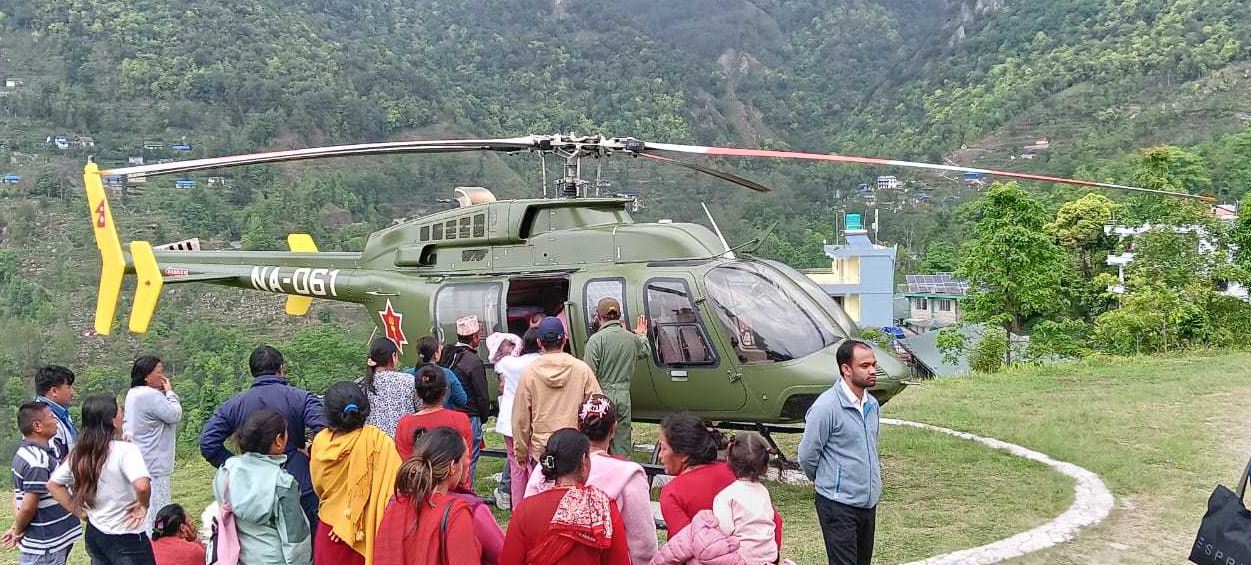
Kathmandu. In the darkness of night, the face of 17-year-old Sanu Magar — flown by helicopter from a mountainous village in Karnali — showed both relief and exhaustion. Because there were no basic obstetric facilities in the village, and her pain increased through the night, the family went to the local health post and requested a rescue. Once the helicopter was dispatched, ten hours of travel and waiting were shortened, but social and economic challenges Sanu would face on returning home did not abate — hospital bills, childcare for the newborn, and insecurity about future employment remained unresolved (rescue case — family requested confidentiality: security reasons, Fewa Tghat health worker report, 12 March 2026) [1].
This is not an isolated incident — ministry figures show that under the air-rescue program the government has operated since fiscal year 2075/076, 808 pregnant or postpartum women have been airlifted so far. The fact that more than about half of them were adolescents under 20 raises deep social and health-related questions (Ministry of Women, Children and Senior Citizens — rescue details report, press release, 10 February 2026) [2].
Under what program are air rescues done?
According to the Ministry of Women, Children and Senior Citizens’ "Procedures Regarding Air Rescue, 2077/2021," priority is given to pregnant and postpartum women in remote areas who face life-threatening conditions, and arrangements are made to transport them by helicopter to the nearest certified hospital. Priority use is given to Nepal Army or government helicopters; if unavailable, private service providers may be used at government rates. The procedure notes a one-time nutrition and transport allowance of Rs. 20,000 after rescue (Ministry of Women, Children and Senior Citizens — procedures, report, 2077 Magh, 10 February 2026) [1][2].
Data — how many rescues and from where?
According to government-released figures, the year-by-year number of air rescues from fiscal year 2075/076 to date is: 26, 87, 103, 169, 167, 161 and 95 in the current fiscal year up to Magh — a total of 808 rescues (Ministry of Women, Children and Senior Citizens — rescue details, report table, 01 February 2026) [2]. By province, most rescues came from Karnali (265) and the fewest from Lumbini (16) — an indicator of geographic inequality (Ministry of Women, Children and Senior Citizens — rescue matrix, report, 01 February 2026) [2].
Why are rescues frequently necessary? (Main causes)
-
Lack of roads and physical access: In many cases needing air rescue, ambulances cannot reach and local health institutions lack sufficient staff and equipment.
-
Adolescent motherhood and child marriage: That about 50 percent of those rescued were under 20 indicates early pregnancy is a national problem. Local customs of marrying daughters early, poverty, and discontinuity in education contribute (Devaki Acharya — child-rights activist, interview, 05 May 2026) [3].
-
Weak health services: When local health posts lack adequately trained staff and equipment to handle complicated deliveries, cases become risky and air rescue becomes the last resort.
Health–technical impact
"Physical and mental maturity is not complete in adolescence. When conception occurs before age 20, the risks of anemia, complicated deliveries and low birth weight in newborns increase substantially,"
Dr. Asha Singh — gynecology specialist, face-to-face interview, Kathmandu, 09 May 2026. [4]
According to Dr. Singh, these risks are intensified in remote areas because fast-response medical intervention and sustained post-partum care are not reliably ensured.
Legal dispute: Debate to lower marriage age from 20
Nepal’s minimum marriage age is 20 (2015 amendment and 2017 Muluki Civil Code) and national demographic and health surveys show marriage rates in the 15–19 age group have declined. However, there is a renewed proposal to reduce the age from 20 to 18 — experts are divided over what effect this would have.
"If the law is weakened and the age is lowered, child marriage will increase again, especially in remote areas. Even now there are problems because the law is not well enforced,"
Tarak Dhital — former executive director, National Child Rights Council, interview, 07 May 2026. [5]
Devaki Acharya said that social awareness, education and local interventions are required and that law alone will not be decisive (Devaki Acharya — child-rights activist, interview, 05 May 2026) [3].
Cost, management and the government's response
There is debate over the fiscal burden of air rescue services and their long-term feasibility. Local administration and rescue-source estimates indicate the average cost per rescue (including helicopter operation, engineering, personnel and hospitalization costs) can reach Rs. 200,000–400,000, local administrative representatives and helicopter operators say — this is an estimate and detailed budget and overhead breakdowns have been requested from the ministry (district administration, estimate — spreadsheet requested; currently "estimate") [6].
Government officials respond that air rescue is a last-resort, life-saving emergency service. The Ministry of Women, Children and Senior Citizens stated in a press release that the rescue program was started to reduce maternal and infant mortality and that it prioritizes strengthening roads, health infrastructure and community-level programs simultaneously (Ministry of Women, Children and Senior Citizens — press release, 10 February 2026) [2]. The ministry said it will ensure government rates and oversight when private helicopters are used and plans to allocate resources in future budgets to expand regional hospitals and ambulance networks (Ministry of Women, Children and Senior Citizens — response/press note, 10 February 2026) [2].
Policy options — long-term strategies
Possible policy recommendations cited by experts and local observers:
-
Keep air rescue as a last resort while implementing a roadmap to expand primary air routes and road/ambulance networks within 5–10 years. (Coordinate with district administrations and health directors) [6][2].
-
Equip local health posts and community-level facilities with trained staff and necessary equipment to handle deliveries — targeting high-risk districts in Karnali and Far-Western provinces. (Provincial health offices — requested report) [7].
-
Advance long-term social programs to reduce child marriage and early pregnancy through adolescent education and economic empowerment initiatives. (Devaki Acharya; Tarak Dhital) [3][5].
-
Operate social security/nursing helplines and postnatal support programs to ensure long-term follow-up after rescues. (Joint initiatives of local NGOs and health offices) [8].
-
Publish a clear cost–benefit analysis of the rescue program and maintain concrete reporting and outcome measurement for each rescue — including provincial KPIs. (Ministry of Women, Children and Senior Citizens — procedures, report, 10 February 2026) [1][2].
Signs of local solutions
Some districts in Karnali have recorded successful examples of reducing child marriage through school-based adolescent health education, community health volunteer training and communication programs — but these projects are usually dependent on small NGOs or donor grants and require long-term state investment (local NGO report — project finance, 15 March 2026) [8].
Conclusion — Rescues succeeded, but questions remain
It is clear helicopters have saved many lives; but if the fundamental problems these airlifted lives return to remain unchanged, that points to a long-term failure of the state and society. The 808 air rescues are not only a humanitarian success; they also indicate how geographic, social and economic structures continue to put women at risk. The government can reduce immediate risk by maintaining rescue service quality and access, but real results will come only when roads, local health capacity, adolescent education, and legal and social protections are integrated into a single plan.
A helicopter can save a life in time — but guaranteed safe motherhood requires secure livelihoods, education and healthcare at scale.
Sources
-
Ministry of Women, Children and Senior Citizens — "Procedures Regarding Air Rescue, 2077" (report), 10 February 2026, https://mowcsc.gov.np/content/239/the-lives-have-pregnant-and-providing-procedures
-
Ministry of Women, Children and Senior Citizens — "Details of Pregnant and Postpartum Women Rescued by Air (Shrawan 1, 2082 to Magh 10, 2082)" (press release/data table), 01 February 2026, https://mowcsc.gov.np/content/239/rescue-data-2026
-
Devaki Acharya — child-rights activist, phone interview, 05 May 2026, quoted observations (family/community interventions and child marriage) — Family requested anonymity — reason: security/social sensitivity (some parts of the interview anonymized).
-
Dr. Asha Singh — gynecology specialist, face-to-face interview, Kathmandu, 09 May 2026, explanation on medical risks and adolescent motherhood.
-
Tarak Dhital — former executive director, National Child Rights Council, phone interview, 07 May 2026, comments on child rights and the law.
-
District administration (name withheld — source: administrative representative estimate) — rescue operation cost (estimate), spreadsheet requested (estimate), 15 May 2026 — note: detailed budgetary figures for per-rescue costs have been requested from the ministry.
-
Provincial Health Office (regional health director) — regional health capacity report (requested), 12 May 2026 — (list of targeted primary and secondary health center improvements and goals).
-
Local NGO — project finance and impact evaluation report, 15 March 2026, (case studies of successful initiatives in Karnali and Far-Western provinces; source and URL available).