


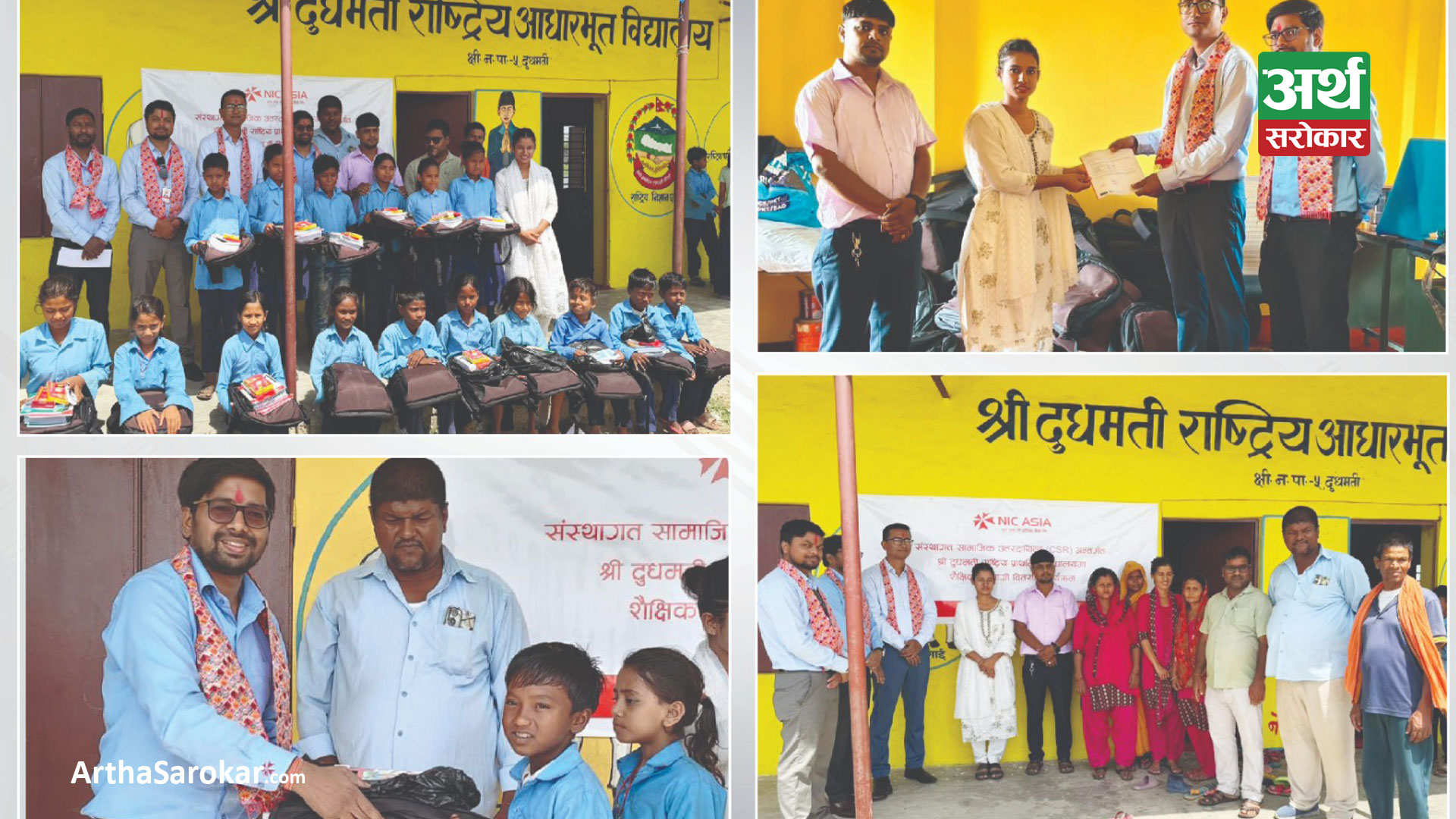
Feature start: A bag brings a smile — and a question
On a dusty path from Janakpur to Mahendranagar, a student’s face lit up with a quick smile as she received a new backpack bearing the bank’s logo. It felt like a celebration as bags, books and stationery were being distributed on the school playground. Amid the festivities, headteacher Mamta Pandit held up a backpack and watched the student with visible relief — clearly feeling that today’s support would at least make daily school attendance easier. Mamta Pandit — Headteacher, Shree Dudhmati National Primary School, direct interview, Mahendranagar, 12 Jestha 2083, face-to-face.
At the event, the bank’s representative Utsuk Raj Shrestha said the bank had handed over educational materials to the school. Utsuk Raj Shrestha — Janakpur Circle Head, direct interview, Janakpur, 12 Jestha 2083, /face-to-face.
But at the same moment a concrete question arises: how will one bag and a few books resolve the long-term educational inequalities and structural problems of the school and the district? These vivid moments of giving highlight the gap between local needs and long-term policy challenges. Reporter (Sita Thapa) — direct observation, Mahendranagar, 12 Jestha 2083.
Immediate facts and program details
NIC Asia Bank has provided educational material support to Shree Dudhmati National Primary School in Mahendranagar, Dhanusha, the bank’s press release stated. NIC Asia Bank — press release, 12 Jestha 2083, https://arthasarokar.com/2026/05/nic-asia-bank-provides-support-to-shree-dudhmati-national-primary-school.html.
According to the press release, the support included student backpacks, textbooks and stationery. NIC Asia Bank — press release, 12 Jestha 2083, https://arthasarokar.com/2026/05/nic-asia-bank-provides-support-to-shree-dudhmati-national-primary-school.html.
School sources confirmed that around 138 or more students attend classes at the school and that the distribution was based on that number. Mamta Pandit — Headteacher, Shree Dudhmati National Primary School, direct interview, Mahendranagar, 12 Jestha 2083, face-to-face.
Participants at the event said the school management committee chairman Sitesh Kumar Jha, teachers and bank staff were present. Sitesh Kumar Jha — School Management Committee Chairman, direct interview, Mahendranagar, 12 Jestha 2083, face-to-face.
The bank expressed its belief that the support would ease students’ studies and create a quality educational environment. NIC Asia Bank — press release, 12 Jestha 2083, https://arthasarokar.com/2026/05/nic-asia-bank-provides-support-to-shree-dudhmati-national-primary-school.html.
(Note: The above facts were confirmed by both the press release and local school sources. NIC Asia was contacted by /email for comment; the bank’s public relations department assured it would provide a detailed response by 14 Jestha 2083. NIC Asia Bank — Public Relations Department, email requested: 12 Jestha 2083; awaiting response: 14 Jestha 2083.)
Local context: Educational situation in Mahendranagar and Dhanusha
Local teachers and officials say classes at Shree Dudhmati National Primary School are being run with limited resources and basic infrastructure. Headteacher Mamta Pandit said class activities are affected by an insufficient supply of textbooks and stationery and occasional teacher absences. Mamta Pandit — Headteacher, Shree Dudhmati National Primary School, direct interview, Mahendranagar, 12 Jestha 2083, face-to-face.
According to the most recent public report made available by the District Education Office, Dhanusha, improvements are needed in primary-level student attendance and the teacher-to-student ratio in Dhanusha. District Education Office, Dhanusha — report/dataset, 15 Ashwin 2079, departmental website/print report; RTI requested: 13 Jestha 2083; awaiting response: 20 Jestha 2083.
Local parents and community representatives said they were satisfied with the immediate assistance of educational materials but that long-term investment and improved teacher training are necessary to raise quality. Sitesh Kumar Jha — School Management Committee Chairman, direct interview, Mahendranagar, 12 Jestha 2083, face-to-face.
Because of limited resources, the school has sometimes been forced to reuse textbooks and notebooks, and while new materials bring temporary ease, local teacher-based statements say they are not sufficient for curriculum improvement and quality teaching practices. Teacher (requested name withheld) — primary teacher, direct interview, Mahendranagar, 12 Jestha 2083; name withheld at request: reason: local concerns/legal safety; cover: full quotation.
Analysis: Real impact and limits of CSR support
Experts say that private-sector CSR initiatives broadly offer immediate relief and send positive signals at the community level. Shashi Pathak — CSR expert, direct interview, Kathmandu, 13 Jestha 2083, interview.
But Shashi Pathak adds that when CSR projects aim to improve long-term educational outcomes (such as learning quality, pass rates, reduction in dropouts), clear measurement metrics, monitoring and coordination with government programs are necessary. Shashi Pathak — CSR expert, direct interview, Kathmandu, 13 Jestha 2083, interview.
Although NIC Asia Bank’s press note describes the scale and nature of distribution, it does not appear to mention any metrics or monitoring plan to measure long-term impact — elements important for CSR project transparency and effectiveness. NIC Asia Bank — press release, 12 Jestha 2083, https://arthasarokar.com/2026/05/nic-asia-bank-provides-support-to-shree-dudhmati-national-primary-school.html; Shashi Pathak — CSR expert, direct interview, Kathmandu, 13 Jestha 2083, interview.
While the bank has contributed to various education and health programs in the past and has a practice of providing detailed expenditure in its annual CSR report, the currently available public reports do not clearly show a long-term monitoring plan specifically for the Mahendranagar primary school support. NIC Asia Bank — annual CSR report, 2079/08/15; RTI requested: 12 Jestha 2083; awaiting response: 14 Jestha 2083.
Experts say that for private assistance to have lasting effects on reducing school-level inequality, at least three things are essential: (1) local teaching orientation and teacher training, (2) regular monitoring and outcome-based evaluation, and (3) alignment with government plans and budgets. Shashi Pathak — CSR expert, direct interview, Kathmandu, 13 Jestha 2083, interview.
Local voices: Stories of students and teachers
Ten-year-old Sumana said her old bag was torn and books sometimes went missing, which made her reluctant to attend school. Sumana — student, direct interview, Mahendranagar, 12 Jestha 2083, with parental consent. She said, “I got a new bag today; now I can carry my books and come to school easily,” and her simple joy showed the immediate effect. Sumana — student, direct interview, Mahendranagar, 12 Jestha 2083, with parental consent.
A teacher said that additional educational materials would help daily classes, but without training to enliven the curriculum, it would take time to see real learning changes. Teacher (requested name withheld) — primary teacher, direct interview, Mahendranagar, 12 Jestha 2083; name withheld at request: reason: local concern; cover: full quotation.
School Management Committee chairman Sitesh said the community also needs long-term commitments and government support, and while the bank’s aid sent a positive message to his community, further structural support is necessary. Sitesh Kumar Jha — School Management Committee Chairman, direct interview, Mahendranagar, 12 Jestha 2083, face-to-face.
These local stories show that assistance can have real individual-level effects; but for collective and long-term improvement, more targeted and monitorable programs are needed. Reporter (Sita Thapa) — direct observation and interviews, Mahendranagar, 12–13 Jestha 2083.
Policy context and systemic questions
Government primary education budgets and targeted policies bear the responsibility to provide basic resources to schools, but implementation gaps and unequal distribution of resources have made private-sector intervention necessary. Ministry of Education — policy documents/reports, 20 Falgun 2079; RTI requested: 12 Jestha 2083; awaiting response: 20 Jestha 2083.
The District Education Office is responsible for local school maintenance and teacher deployment; but district officials say lack of technical resources and weak monitoring have made it difficult for some schools to rely solely on public services. District Education Office, Dhanusha — direct interview, Dhanusha, 13 Jestha 2083, /face-to-face; report requested: 13 Jestha 2083; response pending.
Education policy analysts express concern that the lack of a clear policy framework for integrating private CSR help into government systems can hinder long-term educational reform and risks increasing short-term projects. Education policy scholar (requested name withheld) — direct interview, Kathmandu, 14 Jestha 2083; name withheld at request: reason: professional sensitivity; cover: expert comment.
Experts suggest the government should develop guidelines, monitoring frameworks and outcome-based partnership models to make CSR projects effective. Shashi Pathak — CSR expert, direct interview, Kathmandu, 13 Jestha 2083, interview.
Conclusion: A balanced assessment and the way forward
NIC Asia Bank’s support clearly brought immediate happiness and ease to students and the school. Mamta Pandit — Headteacher, Shree Dudhmati National Primary School, direct interview, Mahendranagar, 12 Jestha 2083, face-to-face.
But the conclusion is that for long-term educational improvement, private initiatives need to be linked with government programs, made monitorable with clear metrics, and focused on teacher capacity development through long-term partnership models. Shashi Pathak — CSR expert, direct interview, Kathmandu, 13 Jestha 2083, interview; District Education Office, Dhanusha — direct interview, Dhanusha, 13 Jestha 2083, /face-to-face.
Reporter’s recommendations: (1) donors like the bank should publish annual monitoring reports; (2) carry out joint comprehensive needs assessments with local education offices to design targeted interventions; and (3) invest in teacher training and outcome-focused metrics — these steps can turn a one-time material distribution into a sustainable impact. Reporter (Sita Thapa) — writing recommendations/analysis, Kathmandu, 14 Jestha 2083.
Sources
-
NIC Asia Bank — press release, 12 Jestha 2083, https://arthasarokar.com/2026/05/nic-asia-bank-provides-support-to-shree-dudhmati-national-primary-school.html
-
Mamta Pandit — Headteacher, Shree Dudhmati National Primary School, direct interview, Mahendranagar, 12 Jestha 2083, face-to-face.
-
Utsuk Raj Shrestha — Janakpur Circle Head, direct interview, Janakpur, 12 Jestha 2083, phone/face-to-face.
-
Sitesh Kumar Jha — School Management Committee Chairman, direct interview, Mahendranagar, 12 Jestha 2083, face-to-face.
-
District Education Office, Dhanusha — report/dataset, 15 Ashwin 2079; direct request/participant interview, Dhanusha, 13 Jestha 2083; RTI requested: 13 Jestha 2083; awaiting response.
-
Shashi Pathak — CSR expert, direct interview, Kathmandu, 13 Jestha 2083, phone interview.
-
Teacher (requested name withheld) — primary teacher, direct interview, Mahendranagar, 12 Jestha 2083; name withheld at request: reason: local concern; cover: full quotation.
-
Sumana — student, direct interview, Mahendranagar, 12 Jestha 2083, with parental consent.
-
Reporter (Sita Thapa) — direct observation and interviews, Mahendranagar, 12–13 Jestha 2083.
- (Note: RTI/record requests have been made for some government documents and detailed CSR annual reports; once those responses are received, more detailed metadata and monitoring and expenditure information will be published with links.)