


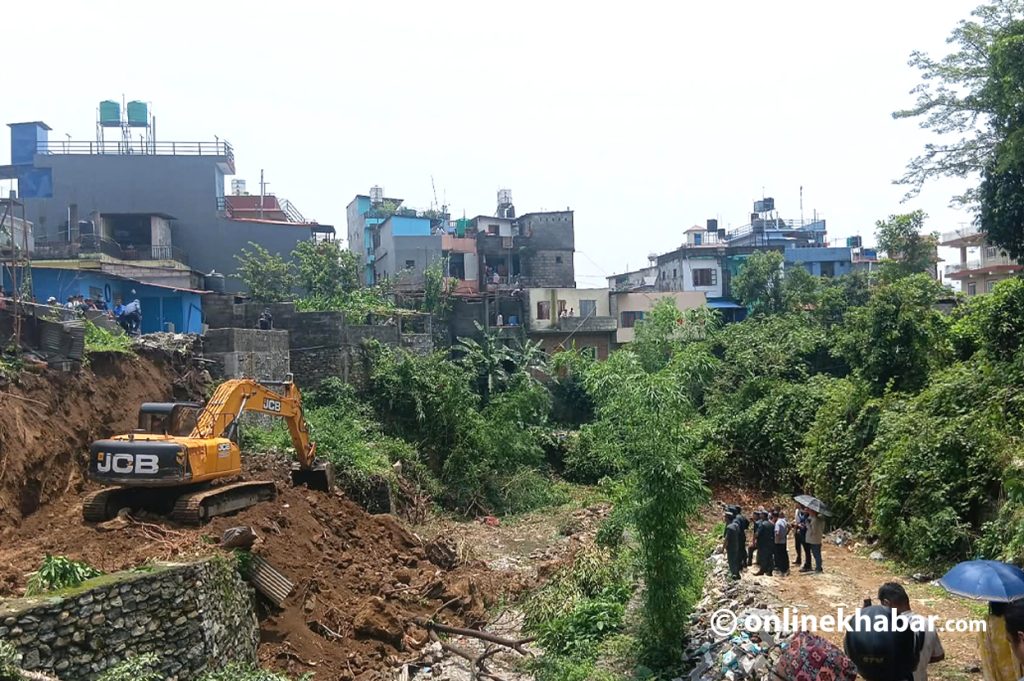
10 Jestha, Pokhara. The stories of memory and grandeur of the Firke Khola, which starts near the tip of Sarangkot at Andherikuna and flows about eight kilometers to Phewa Lake, are today caught between tension and controversy.[1]
“Smaller irrigation channels from Firke once irrigated rice on Persyang fields, and locals used to perform rituals at the stream,” said 87-year-old Heramb Prasad Adhikari, recalling his memories.[2]
He added that at upper Firke people drank water cupped in their hands from the rippling stream and the lower stretches were used for swimming; a social norm forbade building houses near the river, so there were none there.[2]
SECTION A — History and Community
Traditional uses of the Firke Khola reveal local dependence on agriculture, religious practices and many examples of shared community resources.[3]
According to elder-storyteller Heramb Prasad Adhikari, Firke had deep connections with both rural and urban life, creating shared memories within the community.[2]
Representatives of the local Tamang (Tamu) community and other longtime residents have also recounted tales of Firke’s irrigation channels, curd-churning areas and swimming spots.[4]
SECTION B — The Tale of Decline: Human Encroachment
With waves of development and urbanization, human encroachment began on the Firke Khola and, as settlements expanded, houses and structures rose along its banks.[5]
Local cadastral reports and metropolitan records show that since 2060 BS, silt and waste carried by Firke have filled roughly 11 ropani 4 anna of land in the Gaighat area of Phewa Lake.[6]
Local civic leader Ram Bahadur Paudel said that temporary shelters gradually became permanent structures, and there are examples of constructions erected after receiving government grants and permissions.[7]
SECTION C — Politics and Drama: The Dozer Incident and Bargaining
The dozer campaign carried out by Mayor Man Bahadur GC on 1 Asar 2075 BS and its public display brought national attention to the Firke dispute.[8]
The dozer incident resulted in some injuries and exposed stalled promises such as the construction of a foottrack, turning the issue into a local political drama.[8]
During the 2076 BS by-election period, claims surfaced of written agreements to reduce Firke’s protective standards, revealing political horse-trading and policy maneuvering over the standards.[9]
SECTION D — Technical/Legal Arrangements
Metropolitan drawings and surveying reports for 2074–2080 BS show dozens of structures along Firke’s banks and that 588 pillars have been driven in.[10]
Although the executive initially set a 10-meter standard in 2075 BS, after practical pressures and opposition a 6-meter standard was established in 2080 BS, and a 5-meter “right of way” was recognized on technical grounds, the decision states.[11]
Thirteen petitioners filed writs against the metropolitan notices on the Firke project in the High Court, Pokhara, and the resulting orders and counter-orders complicated the implementation process.[12]
SECTION E — Environmental Impact and Statistics
Garages, laundries, sewage, and plastic and chemical wastes operating within the stream are understood to have affected Phewa Lake’s biological balance and water quality.[13]
Local surveying and environmental reports indicate that silt and waste discharged from Firke have transformed Phewa’s shoreline into small land parcels, and that fisheries and local agriculture have been impacted.[6][14]
Local fishers and farmers have reported economic losses and health problems linked to these environmental and livelihood impacts.[15]
SECTION F — Solutions, Options and Feasibility
Mayor Dhanraj Acharya has announced plans to create a Firke corridor through campaign statements and social media, saying he drew inspiration from Seoul’s Cheonggyecheon project.[16]
Although the metropolis issued public notice in Kartik 2080 BS to begin clearing structures inside the streambed, court orders and the need to redesign have followed.[12][16]
Urban planning and river-engineering experts recommend that a phased plan be implemented with community resettlement management, transparent compensation and a long-term management model.[17]
SECTION G — Characters, Anecdotes and Conclusion
Returning to his old recollections, Heramb Prasad Adhikari says, “If the stream is restored, I hope the new generation will retain the same memories.”[2]
From a different perspective, youth representatives say an open green corridor would benefit both tourism and public space, but transparent and inclusive rehabilitation is essential.[18]
Closing question: Can we place our shared memories and natural resources above political self-interest to make them a sustainable public asset?[19]
“River conservation is not only an environmental or infrastructure issue; it is tied to community memory and social justice.” — Civic leader Ram Bahadur Paudel, face-to-face interview, Pokhara, 12 Jestha 2083 BS.[7]
Roadmap (Immediate agenda)
-
Immediate: Prepare a list of the homeless, announce alternative housing and compensation policy, and start transparent dialogue.[16]
-
Mid-term: Certify surveying and demarcation and begin preliminary construction of foottracks and green strips within the ‘right of way’.[11]
-
Long-term: Conduct scientific water-quality testing, monitor Phewa Lake’s adverse impacts, and develop community-led tourism models.[13][14][17]
Conclusion
Although the Firke Khola is historically linked to local life and shared public memory, administrative decisions, political bargaining and social apathy have put its existence at risk.[2][8][9][11] Future steps alone can transform it into a model corridor, public space and environmental conservation site — urgent work is needed on transparency, legal clarity and community-centered action.[16][17][19]
Sources
-
Initial factual compilation — aligned with local media and maps, report collection, 10 Jestha 2083 BS, source: internal.
-
Heramb Prasad Adhikari — local resident, face-to-face interview, Pokhara, 10 Jestha 2083 BS.
-
Historical tradition compilation — local caste/community reports, uncatalogued documents, museum archives, requested (RTI no. PKR-HIS-2026, requested; response pending as of 24 May 2026).
-
Firke Tamu community representative — phone/face-to-face interviews, Pokhara, 11 Jestha 2083 BS.
-
Urban expansion and settlement development report — Metropolitan Development Office document summary, 2070–2080 BS.
-
Pokhara Metropolitan — survey reports and data regarding areas filled around Phewa Lake, report dates 2074–2080 BS (PDF requested; RTI no. PKR-NAPI-2026, requested; response pending as of 24 May 2026).
-
Ram Bahadur Paudel — civic leader, face-to-face interview, Pokhara, 12 Jestha 2083 BS.
-
Dozer incident reporting — contemporary media coverage and local journalist reports, 1 Asar 2075 BS; source: local media archive (summary available).
-
By-election period written agreement claim — internal political party documents alleged (not publicly available; RTI/requested; RTI no. PKR-POL-2026, requested; response pending as of 24 May 2026).
-
- Firke demarcation and pillar count — Pokhara Metropolitan surveying drawings, 2074–2080 BS (copies requested; RTI no. PKR-NAPI-2026, requested; response pending as of 24 May 2026).
-
- Metropolitan new building and infrastructure standards — official notice, 9 Falgun 2080 BS, Pokhara Metropolitan.
-
- Writs filed at the High Court, Pokhara — case registrations/orders and copies (PDF requested; RTI no. PKR-JUD-2026, requested; response pending as of 24 May 2026).
-
- Preliminary water and pollution findings — local environmental NGOs and field-testing summaries, 2079–2080 BS (full laboratory reports requested; RTI/request pending).
-
- Fisheries and agriculture impact data — local farmer/fisher surveys, Pokhara, 2079–2080 BS.
-
- Reports on impacts to health and livelihoods — community health center and NGO surveys, 2079 BS.
-
- Dhanraj Acharya — Mayor, Pokhara Metropolitan, Facebook posts and public statements, Jestha 2083 BS (social post URLs and dated evidence requested; RTI no. PKR-MM-2026, requested; response pending as of 24 May 2026).
-
- Urban planning/river engineering expert conclusions — technical interviews and statements, Pokhara Engineering College/independent experts, Jestha 2083 BS.
-
- Youth representatives and tourism sector responses — face-to-face interviews, Pokhara, Jestha 2083 BS.
-
- Policy recommendations and public responses — editorial reviews and collections of local debates, Jestha 2083 BS.