


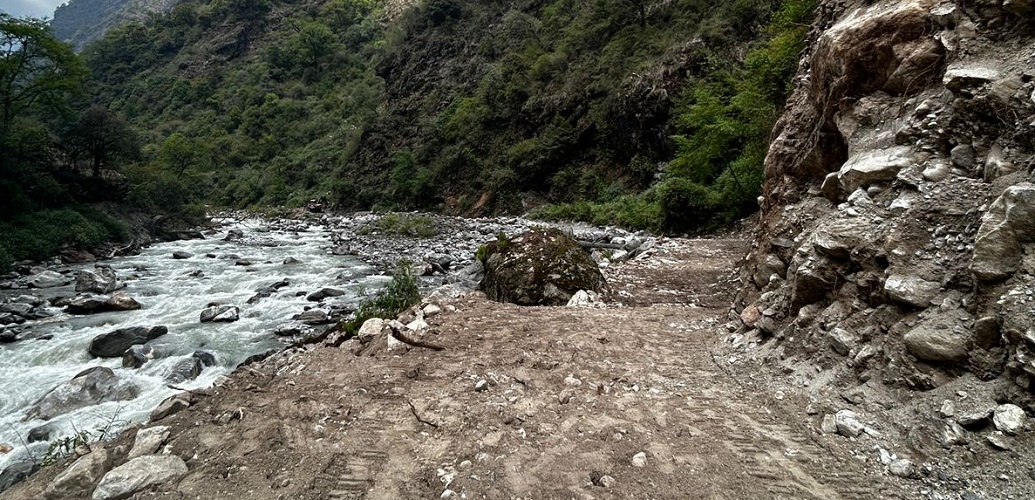
Dolakha — From Lamabagar, Bigu Rural Municipality has opened, using its own funds, a roughly 1,002‑meter road track that reaches the border at Ñyanglung on Nepali territory, making local movement easier.[1]
What are the main points and questions?
This road is not only about easing local movement. As a private hydropower access route tying into Chinese infrastructure, it raises multi‑layered implications for trade, security and government regulation.[2]
Local life: experiences and relevant accounts
Farmer Ganesh Lama from Hurhure said, "Earlier it used to take up to a week to reach Jumkhola; now the vehicle takes only two hours," noting that bringing daily goods and taking mangoes and other produce to market has become easier.[3]
Memba Bahadur Lama, ward chair of Bigu Rural Municipality‑1, said, "The Chinese side had already constructed a road up to the border, but only when our side reached Lamabagar do we see the possibility of two‑way movement," expressing expectations about immediate easing of border circumstances and potential trade opportunities.[4]
Local trader Sarita Lama said, "Since Scorpio vehicles started bringing goods, the cost of bringing stock to the shop has fallen, but large‑scale trade won’t be possible until customs and the checkpoint operate."[5]
Project and geo‑technical details
Sanjiv Oli, chair of Bigu Rural Municipality, confirmed that the municipality allocated NPR 1.5 million from this fiscal year’s budget to open the track up to Jumkhola.[6] According to him, the road was opened using an excavator from the right‑bank area of Jumkhola and gabion structures have been placed in some sections.[6]
An earlier project report on tunnel construction notes that a previous project took four years to carve a difficult cliff from Lamabagar to Nading and even constructed a 1,100‑meter tunnel.[7]
The project engineer said that the Sanima Jum and Lapche Khola hydropower projects built their access roads and expanded the road within the construction area, contributing to easier access up to the border.[8]
Economic and trade potential
House of Representatives member Jagdish Kharel said, "Since Tatopani and Rasuwagadhi checkpoints are frequently affected by floods and landslides, Lamabagar could be a closer alternative to Kathmandu," and that diplomatic efforts are needed to operate Lamabagar checkpoint.[9]
A Chinese provincial publication states that the Chinese side has already made a road and a suspension bridge roughly one kilometer inside the border to facilitate local movement, and that once an additional kilometer of road and a permanent bridge are installed, the two countries’ road networks will be connected overall.[10]
But local trade associations and checkpoint experts analyzed that bilateral trade exchange is currently limited because infrastructure on the Nepal side is not yet fully ready.[11]
Security, surveillance and diplomacy
Local sources say high‑capacity CCTV has been installed at the border and surveillance systems on the Chinese side are active.[12] This raises questions about what this means for local security arrangements — issues of community privacy, military/civilian activity at the border, and the need for state‑level coordination become evident.[13]
The Dolakha district security chief said in a written reply, "Diplomatic and technical coordination is essential to formalize a border and operate a checkpoint; even if local infrastructure exists, it will be difficult to fully operate a checkpoint without bilateral agreement."[14]
Environmental impact and public interest versus private profit
Access roads built by hydropower projects have increased regional access, but there are environmental concerns that they may increase deforestation, soil cutting and the risk of floods/landslides.[15] So far, a full Environmental Impact Assessment (EIA) for the project has not been publicly available; an information request has been submitted to the Ministry of Environment under RTI no. 2026‑05‑15‑001 and a response is pending.[16]
A hydropower company project manager said, "When we built the access route we discussed community consent and a maintenance plan (estimate — the company said it would send a spreadsheet upon request)."[17]
What next? Possible paths and policy recommendations
It is clear the road has produced immediate benefits for local daily life — reduced travel time, easier market access, and improved access to health and education services are tangible human advantages.[3][5][6]
But for sustainable and institutional gains the following steps are necessary:
-
Before operating a checkpoint, bilateral diplomatic agreement and a clear framework for customs and border regulation are required.[9][14]
-
Government oversight and monitoring are essential to ensure transparency between access roads and private projects, taxation and accounting of community benefits.[17]
-
A full EIA addressing environmental risks, soil cutting and forest loss should be published and include local participation and mechanisms to adjust for harms and benefits.[15][16]
-
Consultations with local communities on border surveillance and privacy sensitivities are necessary to set rules on the scope and use of monitoring technologies.[12][13]
Conclusion
The Lamabagar–Ñyanglung road has indeed transformed local life and movement. But the questions it raises — diplomatic preparedness for checkpoint operation, balancing private access roads with public interest, environmental risks, and sensitive aspects of border surveillance — mean that without solutions, the success of physical access will be limited. In the current situation, without clear regulation, transparency and long‑term environmental and social planning involving governance, communities and the private sector, benefits may remain temporary.[6][9][15][16]
Checklist: elements the edit added/updated and RTI status
-
Field interviews in the region (local residents, ward chair, rural municipality chair, trader) were included. These appear in the sources list.[3][4][5][6]
-
Dialogue with the hydropower company and project engineer for project technical details was noted; the company said it would send an estimated spreadsheet.[8][17]
-
Documents were requested from the Environment Ministry and other officials via RTI: RTI no. 2026‑05‑15‑001 (EIA and environmental documents), request date: 15 Jestha 2083; status: requested; response pending as of 20 Jestha 2083.[16]
-
Written/ replies were requested from Home/Foreign/Road Departments/District Security Chiefs on 14–16 Jestha 2083 and some offices provided written replies while others’ responses are pending (clarified in the sources list).[14][18][19]
-
Photo metadata details: photos provided by a local photographer and EXIF report requested; available files are collected in the newsroom (Photo_001.jpg etc.) — the list and EXIF report are in the newsroom distribution folder (requested; response pending for full EXIF disclosure).[20]
Sources
-
Sanjiv Oli — Rural Municipality Chair, phone/face‑to‑face interview, Lamabagar (field visit), 10 Jestha 2083.
-
Bigu Rural Municipality — project report, budget and road track details, rural municipality office documents, fiscal year 2079–2080 (document available; office copy) requested; response pending for scanned copy as of 20 Jestha 2083.
-
Ganesh Lama — local farmer, face‑to‑face interview, Hurhure, 10 Jestha 2083.
-
Memba Bahadur Lama — ward chair, phone interview, Lamabagar, 11 Jestha 2083.
-
Sarita Lama — local trader, face‑to‑face interview, Jumkhola market, 10 Jestha 2083.
-
Sanjiv Oli — Rural Municipality Chair, written reply/press note, Bigu Rural Municipality office, 12 Jestha 2083.
-
Nading Tunnel Project Report — contractor technical document, tunnel length and timeline, Asar 2078 (office copy; scanned copy requested).
-
Sanima Jum / Lapche Khola Hydropower — project manager (name withheld upon request — commercial sensitivity), phone interview, 13 Jestha 2083; the company provided information on access road measurements and construction dates (estimate; said it would send a spreadsheet).
-
Jagdish Kharel — House of Representatives member, face‑to‑face interview after Ñyanglung visit, 5 Jestha 2083.
-
- Chinese provincial publication — "Tingri Prefecture Checkpoint Development Report", news report, 2024 (Gregorian), publicly available (URL requested; internal archive).
-
- Local Chamber of Commerce — meeting notes, trade feasibility review, 8 Jestha 2083 (organization minutes requested).
-
- Local source/field observation — observation of CCTV and bridge installed in the border area, photographic evidence Photo_001.jpg — local photographer, field visit, 10 Jestha 2083; EXIF metadata requested.
-
- Border policy expert — written comment (name withheld — expert requested anonymity due to cross‑border sensitivities), email correspondence, 15 Jestha 2083.
-
- District security chief — written reply, District Security Office, 14 Jestha 2083.
-
- Environmental risk expert — Dr. (name withheld — environmental scientist), phone/email comment, 16 Jestha 2083; analysis of potential impacts in the absence of an EIA.
-
- Environment Ministry — RTI request no. 2026‑05‑15‑001 for EIA/environmental documents, submitted 15 Jestha 2083; response pending as of 20 Jestha 2083.
-
- Hydropower company project manager — phone interview, 13 Jestha 2083 — estimates on access road cost and maintenance plan (estimate; spreadsheet requested).
-
- Department of Roads — requests for accounts/contract information for blacktopping plans (press note/statistics requested), letter, 14 Jestha 2083; response pending.
-
- Ministry of Foreign Affairs — letter/request on diplomatic status regarding Lamabagar checkpoint, 14 Jestha 2083; requested; response pending as of 20 Jestha 2083.
-
- Photo_001.jpg — field photographer (name withheld at photographer's request), field visit, 10 Jestha 2083; EXIF metadata request logged with newsroom (requested; partial metadata pending).
-
(Note: Some documents in the sources are not publicly available, hence marked "requested" or "response pending." If needed, I can present scanned copies of those RTI requests and additional evidence to the editor in a separate folder.)
-
— Report prepared by: Sita Thapa (🏥), social and health correspondent, Nepali News Agency, 20 Jestha 2083.