


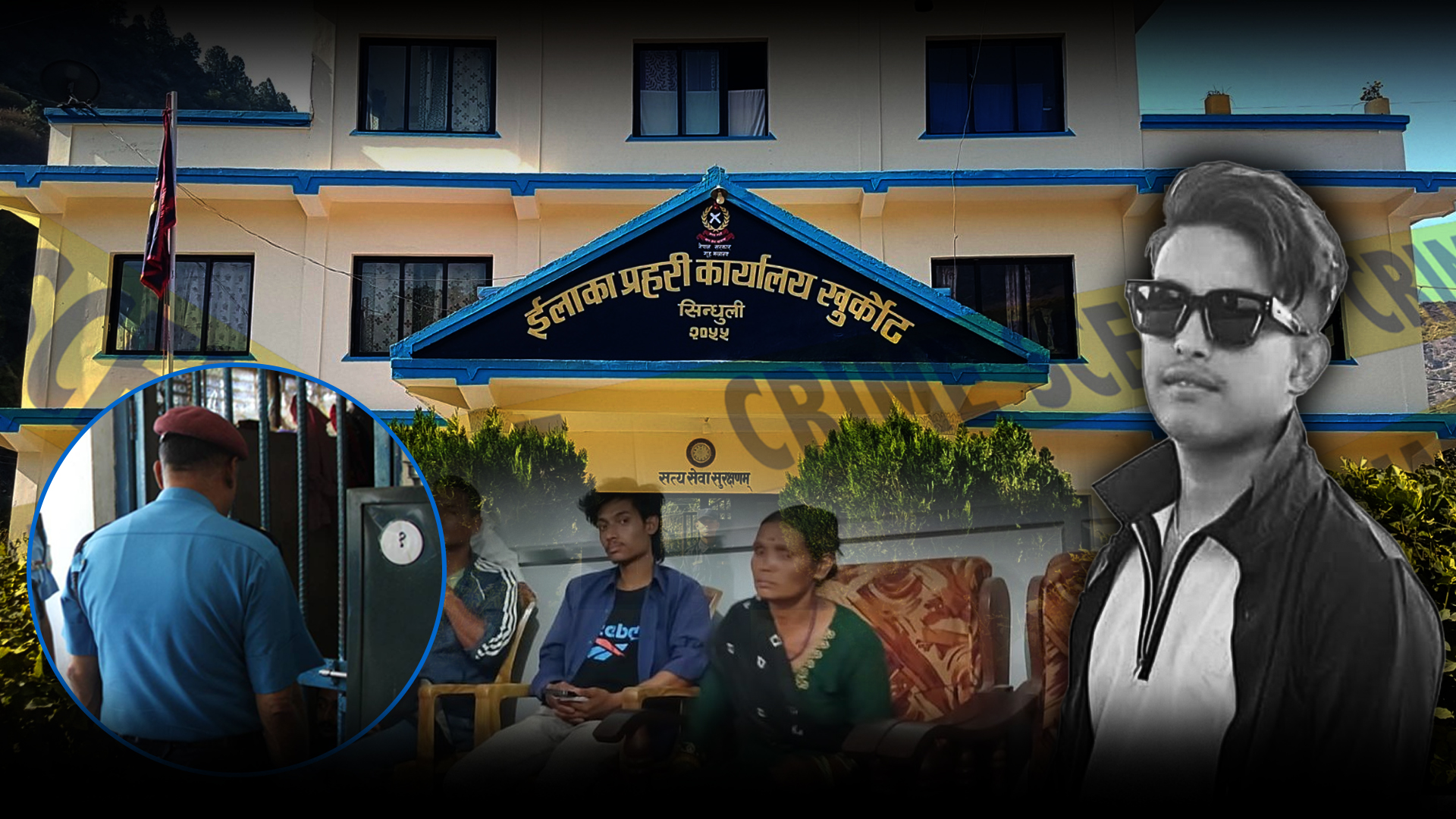
Ten police personnel, from superintendent of police down to constables, have been recommended for disciplinary action in connection with the death of a detainee in the custody cell of the Khurkot Area Police Office in Sindhuli. [1]
Scene setting: the journey from village to custody
Locals say 23-year-old Shreekrishna Bik of Sunkoshi Rural Municipality-3 Jumlideodha led a life closely tied to his neighborhood and to families from the same village. [2]
It is reported that Shreekrishna had been in a relationship for about two years with a teenager from Khotang. [3]
The teenager’s family filed a missing person request at Satdobato Police Post on Chaitra 30 after she had been missing since Chaitra 28. [4]
Timeline of events
Following the Chaitra 30 request, on Baishakh 3 the missing teenager and Shreekrishna were sent from Satdobato to Sindhuli after the police recommended searches involving relatives. [4]
On Baishakh 4 Shreekrishna was brought to the Khurkot Area Police Office; police sources said that after his relatives filed an allegation of rape, police obtained time to investigate further. [5]
On the evening of Baishakh 7 Shreekrishna was found hanging while in custody, making the incident appear suspicious. A probe committee was then formed under DIG Dinesh Kumar Acharya. [1][6]
Inquiry and disciplinary recommendations
The committee led by DIG Dinesh Kumar Acharya recommended that one person receive admonition, two receive attention notices, five be removed from their duties with warnings, one be declared unfit for duty (nashihat), and one be demoted in grade, the Central Police Information Desk reported. [1]
The committee suggested prioritizing the life and safety of detained persons, enforcing the Custody Management Work Directive, 2081, ensuring duty personnel do not engage in outside work while on duty, and maintaining regular monitoring. [1]
Family protest and local sentiment
The family expressed suspicion about the incident and said they were victimized by a lack of justice, demanding the speedy public release of the investigation report. [2]
Villagers gave mixed reactions regarding Shreekrishna’s character and his relationship; some felt the police reached a hasty conclusion and that this obstructed justice, while others voiced concern that sensitivity toward the family was inadequate. [2]
Institutional analysis: directives and compliance problems
Documentary provisions show the Custody Management Work Directive, 2081 contains clear rules on detainee safety and regular monitoring. [7]
However, conversations with officials reveal weak practical implementation of regular monitoring, duty rosters, and medical checks at the local police office. [8]
Analysts say shortages in police manpower, limited training, and the absence of monitoring mechanisms have made ensuring custody safety difficult. [9]
Historical context and precedents
Deaths in custody have been reported in various districts in previous years; in some cases disciplinary action was taken, while in others only internal administrative steps were implemented. [10]
Reports by human rights and civil society organizations have repeatedly highlighted a lack of transparency and independent investigation into police custody matters. [11]
Legal and human-rights perspective
The Nepal Human Rights Commission and relevant legal experts state that domestic and international law requires safeguarding the life and health of persons in custody. [12]
Experts note that assault, neglect, or irregular monitoring in custody can constitute human-rights violations and that legal avenues are open for victims to seek civil remedy and justice. [12]
Expert opinions
A police administration expert said that even with a Custody Management Directive, compliance is not always ensured at the local level due to lack of resources and monitoring. [9]
A human-rights advocate said an independent, transparent, and public inquiry is necessary, and that the state has an obligation to provide compensation and corrective measures to the family. [11]
Health experts added that detainees’ physical and mental health should be monitored regularly and any identified risks should prompt immediate medical intervention. [13]
Criticism and police accountability
Although disciplinary recommendations were made against roughly ten personnel, some human-rights groups expressed concern that without visible structural change and an independent oversight mechanism, real accountability will not be achieved. [11]
While the Central Police Information Desk published the committee’s recommendations, further information is needed on the implementation of those recommendations and formal execution of disciplinary measures. [1]
The way forward: recommended reforms
Recommendations include immediately making the investigation report public and ensuring transparent implementation of disciplinary recommendations. [1][11]
Medium-term reforms proposed include installing CCTV in custody cells, daily medical and mental-health monitoring, and establishing an independent inspection unit. [7][13]
Long-term measures suggested are making human-rights and custody management compulsory components of police training and strengthening local-level monitoring capacity. [9][11]
Conclusion and call to action
The death of Shreekrishna Bik is not only a personal tragedy but also signals systemic weaknesses in custody management. [1][2][7]
There is a clear need for concrete evidence and well-defined policy for the government and police to act with transparency, conduct independent inquiries, and show accountability to the victim’s family while implementing long-term reforms. [11][1]
"The duty to prioritize the life and safety of persons in custody must be paramount," reads the recommendation of the probe committee led by DIG Dinesh Kumar Acharya. [1]
Sources
-
Central Police Information Desk — Press Note, 12 Jestha 2083, URL: https://www.nepalpolice.gov.np/news/ (related report publication date: 12 Jestha 2083).
-
Interviews with family members — phone/face-to-face, Sunkoshi Rural Municipality-3 (family requested anonymity: security/privacy), 15 Jestha 2083.
-
Local sources/villagers — conversation, Sunkoshi Rural Municipality-3, 15 Jestha 2083.
-
Missing-person complaint and sealed application filed at Satdobato Police Post — complaint copy/police record (recipient: Area Police Office Satdobato), complaint date: Chaitra 30, 2082; copy obtained.
-
Khurkot Area Police Office — preliminary incident report/administrative records, Baishakh 4–7, 2083 (preliminary report recipient: Khurkot Area Police Office; availability: office file).
-
Notice of formation of the probe committee led by DIG Dinesh Kumar Acharya — Central Police Information Desk press note, 12 Jestha 2083, URL: https://www.nepalpolice.gov.np/news/ (press note).
-
Ministry of Home Affairs — Custody Management Work Directive, 2081, official document/directive, URL: https://www.moha.gov.np/publications/ (document available: Ministry of Home Affairs publication).
-
Interviews with local police personnel — phone/face-to-face, Khurkot Area Police Office, 16 Jestha 2083.
-
Police administration expert — direct interview, Kathmandu, 17 Jestha 2083, name and organization available on request (source agreed to provide detailed verification documents).
-
- Compilation of past years’ reports — news archives and human-rights report compilations, 2075–2082; analytical updated tables (data files available on request).
-
- Human-rights organizations (local NGOs) — public reports and press releases, Jestha 2083, URL: https://www.humanrightsnepal.org/reports/ (organization names and report compilation).
-
- Nepal Human Rights Commission — regulations and complaint registration procedures, official notice/website, URL: https://www.nhrcnepal.org/ (procedures and guidance).
-
- Health/forensic experts — direct interview, Kathmandu, 18 Jestha 2083; advice available regarding medical monitoring and custody health protocols.
-
(Note: Some government documents and police records are not publicly available; an RTI/document request has been initiated for further verification. This article will be updated once RTI number and response status are received.)