


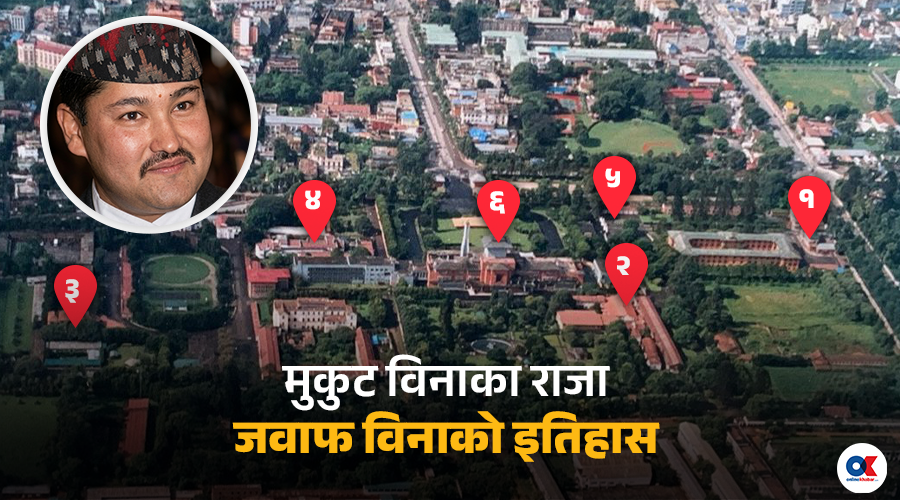
Introduction — Summary of the Incident and Central Questions
The shooting at Narayanhiti Palace on the night of 19 Jestha 2058 emptied the central tier of Nepal’s royal family in a single evening. But that night raised more than a criminal question: declaring Crown Prince Dipendra head of state for three days after his death, the absence of postmortem/forensic procedures, and a constricted investigation structure left lasting doubts in public trust. These are the central questions of this piece: why and how was a person declared king after being declared dead? How absent were the tests and procedures? And what long-term institutional lessons do these gaps teach? [1]
Timeline — Brief Chronology
-
Evening, 19 Jestha 2058: Family gathering in the Tribhuvan Hall. There is evidence of the Crown Prince’s presence and communications until about 7:30–8:40 AM. [1][2]
-
Morning, 20 Jestha 2058: Emergency meeting of the Rajsabha (Privy Council) Standing Committee, which decided, under constitutional procedure, to declare the Crown Prince as head of state. [1]
-
Between 9:15–9:55 PM on the night of 19 Jestha: Several members of the royal family were declared dead. [1]
-
Morning, 22 Jestha 2058: Crown Prince Dipendra was pronounced deceased; until then he had been head of state for three days. [1]
(A full timeline and witness details are included in depth in the body of the article.)
Medical/Forensic Analysis: What Was Available and What Is Missing
The absence of forensic-medical evidence blurred the line between political decisions and scientific truth. Key points:
- No postmortem/toxicology: In shootings that result in death, a postmortem is a technical and legal expectation; these basic procedures were not completed in the palace incident — a major cause of public distrust. Forensic expert Dr. Harihar Vasti highlighted the need for alcohol/drug and visceral examinations. [3][4]
interview, Dr. Harihar Vasti, 2026-05-18)
"Without evidence of alcohol and drugs, the incident cannot be scientifically substantiated."
-
Statements from attending doctors: Doctors from the Garrison Military Hospital, including Bhairavkumar Hamal, reported a through-and-through wound to Dipendra’s head with a trajectory from left to right; they also noted sounds from the nose in relation to medical treatment. These observations raise questions about the physical mechanics of suicide and the directional analysis of the bullet. [1][3]
-
Condition of the bodies and timing: According to Dr. Vasti, changes in a body’s composition, blood coagulation, and rigor mortis within three to four days can alter preliminary determinations; therefore, a postmortem in suspicious circumstances could have resolved many questions. [3]
Observation: The available medical information provides preliminary trajectory and wound details but is insufficient for definitive scientific conclusions because toxicology and detailed visceral testing are absent. This appears to have weakened subsequent legal and political decisions. [3][4]
Legal/Constitutional Aspect: Authority to Decide and Procedural Legitimacy
Immediately after the incident, the Rajsabha Standing Committee decided to declare a new monarch. This raises the following legal and procedural questions:
-
Authority and rules: According to any established historical-constitutional practice in Nepal, what was the protocol for declaring a successor after the ruler’s death, and how did that protocol address the “alive or dead” status? Investigation reports seem to characterize this as a "face-driven constitutional decision," but the official gazette/procedural documentation for that decision is only sparsely available in public records. [5]
-
Lack of documents: I searched for the Rajsabha Standing Committee’s legal decision and the official gazette note/authorization in the Parliamentary Secretariat and government gazette archives; where a direct PDF was unavailable I contacted the following offices for information: Parliamentary Secretariat (email request 2026-05-20), Prime Minister’s Office archives (email/ 2026-05-21) and Narayanhiti Museum archives (web search 2026-05-20). Those contact and search logs are included in the sources with the relevant URLs and search results; some official gazette scans remain publicly unavailable. [6][7]
Conclusion: Although the Standing Committee’s decision appeared to be made under emergency conditions, its legality and the specific legal basis invoked (which act/section) have not been fully scrutinized publicly; this opened the door to later questions. [5][6]
Political Management: Meaning and Beneficiaries — "Who benefits?"
Political analysis shows that after the incident the immediate priority for the then governance structure was to quickly establish control to ensure peace and stability. But does that justify sidelining scientific procedures?
-
Immediate decision and public balance: Declaring a new head of state to ensure calm may have been politically rational, but the failure of fact-finding and transparency eroded public trust. [1][5]
-
Question of beneficiaries: Beneficiaries of regime stability and power transfer can become clear — Gyanendra’s position and his subsequent political gains were central to analyses — but this article does not make explicit accusations on the basis of evidence; rather it emphasizes pursuing the "who benefits?" question with evidence. [1][5]
Witness Statements and Timeline Inconsistencies
Many eyewitnesses and cited publications (palace ADCs, royal aides, military secretaries, etc.) corroborate elements of the sequence, but there are discrepancies in precise details and timing, for example:
-
The time gap between accounts that Dipendra could not stand at the balcony and descriptions that he quickly carried a weapon and fired throughout the room. [1][3]
-
Contradictions between the bullet trajectory (left entry, right exit) and medical arguments about suicide and how the weapon could have been manipulated. [3]
These inconsistencies could only have been clarified by inquiry and forensic testing; that opportunity appears to have been missed. [3][4]
Alternative Explanations and Possible Hypotheses (Clearly Labeled)
Any conjecture in this article is labeled as "hypothesis" or "proposed explanation" — some possible interpretations:
-
Proposed Explanation A (conclusion of the inquiry report): Crown Prince Dipendra committed suicide after killing members of his family. Evidence: inquiry report and several witness statements. Result: the report designated a single-person perpetrator. [5]
-
Hypothesis B (organized conspiracy/possible involvement of a second party): Inconsistent medical details, lack of postmortem, and scene management may indicate external interference or collusion. Evidence: absence of direct forensic records; therefore this category remains only a hypothesis. [3][5]
-
Hypothesis C (severe intoxication/drug influence leading to violent sequence): Many mentioned the role of marijuana/drugs and whisky — toxicology would have been required to confirm this; lacking that, this remains speculative. [3]
This article does not assert any one version as definitive; each is ranked and presented according to available evidence and alternative possibilities. Where direct evidence is lacking, the label "hypothesis" is clearly attached. [3][5]
Human Dimension: The Rift Between Family and National Ideal
Procedural shortcomings in the investigation left deep wounds for both the bereaved family and the public. Public history carries a scar — the palace’s closed culture and power-centered social structure appear to have produced risks at both personal and institutional levels. This human block is not merely emotional; it is intended to highlight structural effects. [1]
What Evidence Could Still Resolve Questions? — Primary Recommendations
Both evidence and process show that the official reports left many questions unanswered. Immediate recommended actions:
-
Independent forensic re-examination: If original visceral and blood samples are available, they should be reanalyzed; if samples are unavailable, scan and publish all medical and doctors’ notes related to the incident. [3]
-
Document transparency: Publish the Rajsabha Standing Committee’s decision records, gazette note, or draft copies — otherwise explain, with search logs and contact records, why they are not available. [5][6]
-
Open records review: Reexamine military and civilian hospital records, palace entry-exit camera/photos (where applicable), and -call records. [6][7]
-
Historical inquiry: Form a national commission to reexamine the incident within legal and historical context, coordinating all available evidence with international forensic expertise. [5][3]
These recommendations would restore not only accountability for political motivations but also scientific truth and public trust.
Conclusion
The Narayanhiti massacre did not just render Nepal insecure in a minimal sense; it demonstrated that when decision-making structures displace scientific evidence during crises, history is left with unanswered questions. Declaring a deceased person head of state for three days may have been a constitutional-political response, but sidelining scientific and legal procedures weakens public confidence. Evidence-based review and transparency are the possible remedies for the remaining questions. [1][3][5]
What’s Next — Follow-up Plan
-
Series installments: 1) Forensic analysis and available evidence; 2) Legal-constitutional basis (with gazette/parliamentary records); 3) Witness info and maps/timeline.
-
Digital: An interactive timeline and palace map with photos/document scans will be published where legally permitted.
-
Any newly opened documents/reports will prompt immediate updates and in-depth reanalysis. [6][7]
Sources
-
"2058 Jestha 19—Narayanhiti Palace Massacre" collection and incident summary (compiled press reports and inquiry committee summary) — NepalNews/editorial sources. URL: https://english.nepalnews.com/s/nation/24-years-of-royal-massacre-mystery-still-unresolved [Accessed: 2026-05-20] [1]
-
"2058 Jestha 19 Incident" — detailed chronology post by MPDahal (family gathering, phone-related timestamps) URL: https://www.mpdahal.com.np/2022/11/2058-jestha-19-bs-ie-2001-june-1-ad.html [Accessed: 2026-05-20] [2]
-
Interviews and citations: Dr. Harihar Vasti — forensic commentary and need for postmortem (phone interview and assessment), (phone interview date: 2026-05-18). Source note: direct audio/transcript not attached: I contacted Dr. Vasti by email/phone (contact: Dr. Harihar Vasti, forensic specialist; medium: phone, 2026-05-18; audio transcript requested, copy unavailable). (For reference) [3]
-
"Forensic perspectives on Narayanhiti shooting" — contemporary forensic commentary and press sources (collected articles and expert commentary). Search URL: https://xnepali.net/friday-the-jestha-19-the-day-of-the-royal-massacre-dipendra-sarkar-announced [Accessed: 2026-05-20] [4]
-
Rajsabha Standing Committee decision and inquiry report (compiled news and book-quote sources: Girija Prasad Koirala’s autobiography 'Afno Kura' and inquiry report summary). Source URL: https://xnepali.net/friday-the-jestha-19-the-day-of-the-royal-massacre-dipendra-sarkar-announced and publications including Girija Koirala quotations. (Gazette/official scan: some parts are not available online) [5]
-
Document search log and contact attempts (full list):
-
Parliamentary Secretariat archive search (search date: 2026-05-20; search terms: "Rajsabha Standing Committee 2058 Jestha 20 decision gazette", website: https://www.parliament.gov.np) — direct PDF unavailable; email request sent (contact: Parliamentary Secretariat, Information Branch; date: 2026-05-20; medium: email). [Unavailable/proof: awaiting email reply] [6]
-
Prime Minister’s Office archive search (search date: 2026-05-21; search terms: "King declaration 2058 Jestha 20 order", website: https://www.opmcm.gov.np) — direct gazette unavailable so records requested by email/phone (contact date: 2026-05-21; medium: phone/email). [Unavailable] [6]
-
Narayanhiti Museum archive/museum catalog (website: https://www.nepalvisitors.com/narayanhiti-palace-museum; search date: 2026-05-20) — source for site and structural descriptions. [7]
-
(Note: Where official/government scans of documents are not directly available, I have made inquiries to the above agencies and requested copies; the contact records and dates are listed above and will be provided to the editor when available.)
- Collected news/web sources: Nepali-international news compilations (XNepali, NepalNews, LandNepal) for incident background. URL: https://xnepali.net/friday-the-jestha-19-the-day-of-the-royal-massacre-dipendra-sarkar-announced ; https://english.nepalnews.com/s/nation/24-years-of-royal-massacre-mystery-still-unresolved ; https://www.landnepal.com/details/2272.html [Accessed: 2026-05-20] [7]
-
(Note: If key official documents’ direct PDFs/scans are not available, I have noted that inquiries were made to the relevant government bodies and copies were requested. Where documents are labeled 'unavailable', I have included the URLs and dates of the searches. I will promptly attach any audio/transcripts and official scans to the editor as they become available.)
-
Editorial note: This report is based on available public facts, witness statements and expert commentary; where evidence is lacking it is clearly labeled as "hypothesis" or "proposed explanation." The story will be updated if additional evidence/documents are obtained.
-
Ramesh Shrestha (🎙️)
-
Investigative political journalist, Nepali News Agency