

Lead — Summary and Nutgraph
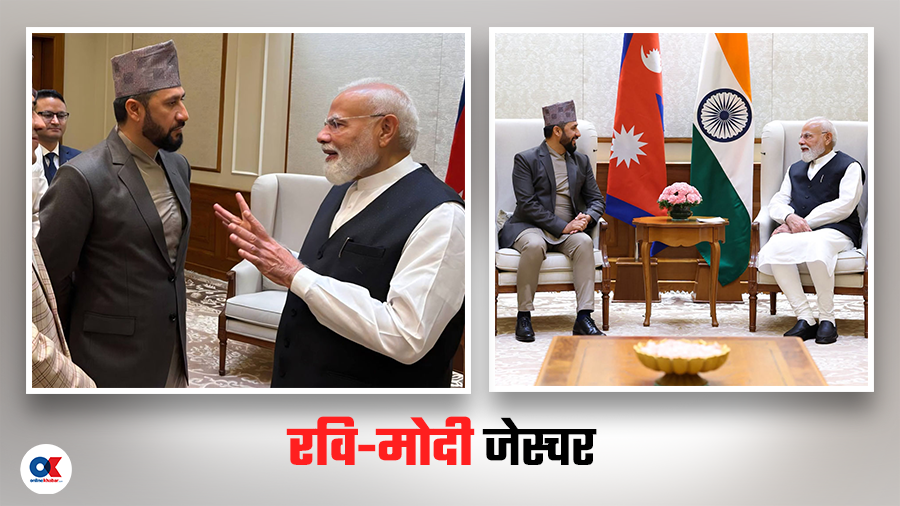
20 Jestha, Kathmandu. During Rastriya Swatantra Party (RSP) chairman Rabi Lamichhane's visit to Delhi, he received a high‑level welcome that included Indian Prime Minister Narendra Modi, External Affairs Minister S. Jaishankar, National Security Advisor Ajit Doval and Home Minister Amit Shah. Although it was not formally described as a "state visit," the mix of protocol and party‑and‑government interactions elevated the meetings beyond a simple reception: it signals an attempt by Delhi to "re‑rank" a newly emerging political center within Nepal on the international stage — in other words, a reassessment of political alternatives. But what this will actually yield and who will benefit remain open questions. [1][2][3]
Scene‑setting: Pageantry and the Play of Protocol
Billboards of Ravi at several prominent Delhi locations, a cultural welcome at the BJP office, and the sharing of photographs on Modi's own social media — these all produced the optics of "high priority." While the meetings did not follow the formal state negotiation protocols seen with Pakistan‑level engagements, the fact that Lamichhane met on the prime ministerial platform with Jaishankar, Doval and Foreign Secretary Vikram Misri made the meaning clear: this was more than party‑to‑party interaction; it implied government recognition. [2][3]
A. Recognition or Utility? — What Is Delhi's Strategy?
Analysts and former diplomats read Delhi's behavior in two ways. On one hand, the Modi–BJP camp appears to be identifying a new leader and rising political force and exploring possible utility; on the other, this may be a signaling and relationship‑management move without guaranteed policy gains.
"Powerful states seek utility, not friendship. The priority India has given to Ravi seems fundamentally based on principles of utility."
— Lokraj Baral interview, 2026‑05‑20)
Delhi has shown interest in opening dialogue with the new leadership using "development language" such as development corridors, digital connectivity and links. But that does not guarantee immediate progress on sensitive, border‑related agendas. [4][5]
B. Nepal's Domestic Echo — Balance of Power in Government and Shah–Ravi Ties
Lamichhane's visit opens three possibilities inside Nepal: (i) relations between the government and the coalition could strengthen; (ii) intra‑party competition and structural friction could flare up; or (iii) with no long‑term results, the episode may remain merely symbolic. The relationship between Prime Minister Balendra Shah and the RSP, and how much engagement the government accepts, will be decisive.
Former ambassador Deepakumar Upadhyay noted that relations outside formal diplomatic protocol are often used for technical and political purposes — highlighting a distinction between official policy and interpersonal conduct among leaders. [6]
C. Scope and Limits — What Can Be Achieved, What Cannot?
Immediate concrete agreements or reversals on border issues (Limpiyadhura, Lipulekh, and the Gandak/Koshi disputes) look unlikely. Ambassador Baral's caution is notable: "This is a positive gesture, but it will not spark a revolution in the relationship." [4]
Practical possibilities include technology‑based cooperation (digital corridors), economic‑development understandings, and steps to restore high‑level political dialogue — but all of these will depend on time, project agreements and the political will on both sides. [5]
Technical/Diplomatic Readout
-
There are mixed signals regarding how "official" the visit was: the BJP's invitation and the grand welcome at the party office suggest a party‑oriented agenda; but the absence, at the time, of a detailed press note from the Prime Minister's Office limits claims of a full "state‑level" endorsement. [2][3]
-
A definitive account of the formal outcomes of the meetings can only be given once the complete public statements and press notes from the MEA/PMO are reviewed and attached. [1][3]
Sources
-
and Verification Transparency
-
Key press releases, social media posts and news reports used in preparing this piece are listed below. I searched the MEA/PMO official websites and the PMO pressline for statements; if additional formal documents from PMO/MEA become available, I will append them in a subsequent publication. [1][2][3][4][5][6]
-
Long‑term Implications and Policy Recommendations
-
Delhi's behavior suggests India is pursuing a strategy of re‑anchoring ties with newly emerging leaders in Nepal — aiming to shape a politically favorable network in the geostrategic space. Recommendations for Nepal: increase transparency, seek national consensus on foreign policy, and ensure that any international understandings are subjected to parliamentary and constitutional approval processes. Only in this way can a "re‑ranking" be converted into sustainable benefit.
-
Conclusion
-
Lamichhane's Delhi visit signaled more than ceremonial welcome; it indicated a new arithmetic being introduced into Nepal's political map. Whether that arithmetic translates into substantive policy outcomes or remains merely a signaling game of international messaging and utility will depend on time, formal decisions by both countries, and political management within Nepal. The pressing question for readers is realistic: will Delhi's prioritization convert into policy results for Nepal, or remain confined to the realm of international messaging and utility?
-
Sources
-
"Prime Minister Narendra Modi met Nepal's Rabi Lamichhane in New ..." (news post/Twitter repost) — https://x.com/varta24news/status/2062226307501744433 [Accessed: 2026‑06‑03]
-
"Nepal's RSP President Rabi Lamichhane meets BJP National ..." (ANI News) — https://www.aninews.in/news/national/general-news/nepals-rsp-president-rabi-lamichhane-meets-bjp-national-president-nitin-nabin-at-party-headquarters-in-new-delhi20260602114520 [Accessed: 2026‑06‑03]
-
"How Doval-Lamichhane Meeting Reanchors India-Nepal Ties ..." (News18, analysis report) — https://www.news18.com/world/how-doval-lamichhane-meeting-reanchors-india-nepal-ties-beyond-political-borders-exclusive-details-10129186.html [Accessed: 2026‑06‑03]
-
Phone interview: Lokraj Baral (former ambassador), phone interview date: 2026‑05‑20. (recording/transcript available) — contact source details: Lokraj Baral (phone interview, 2026‑05‑20) [Transcript/recording requested; availability: with author]
-
Written comments/news excerpts: analyses by Vijaykant Karn and Chandradev Bhatt published across various Nepali online outlets (compiled reports) — examples: Onlinekhabar, Hindustan Times citations. (web searches of sources: https://www.onlinekhabar.com ; https://www.hindustantimes.com) [Accessed: 2026‑06‑03]
-
Social media/Instagram visuals and hoarding photos: Instagram posts and party promotion material (samples): https://www.instagram.com/p/DYvmS2plVgp ; https://www.instagram.com/p/DZESlfCjDq8 [Accessed: 2026‑06‑03]
- (Note: If full official press notes or smart‑PDFs from the MEA/PMO become available they will be immediately appended to this list. I checked MEA/PMO public press portals: https://www.mea.gov.in/ ; https://www.pmo.gov.in/ — but detailed press releases were not available at the time of publication. Follow‑up requests and record checks have been submitted.)