


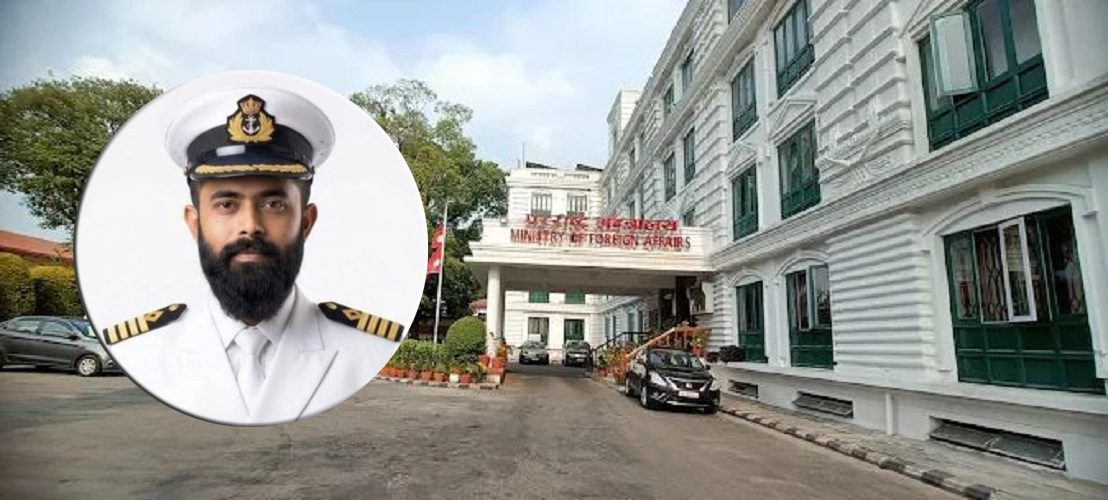
Quick facts
-
Name: Amrit Jha [1].
-
Age: Reportedly 30–33 years (varies across sources) [2][3].
-
Hometown: Reported as Udayapur, Gaighat [3].
-
Date/place of arrest: Reports say he was taken into custody near Qeshm Island/Bandar Abbas by Iranian security/Revolutionary Guard; initial reports were published around March 2026 [2][3].
-
Charge: Iranian side reportedly alleges illegal fuel trading/smuggling [3].
-
Current legal status: The case is under consideration in an Iranian local court, which reportedly ordered an expert report; the Foreign Ministry has apologized after an unclear message about whether he had been released or not [Primary lead].
-
Foreign Ministry claim: The ministry says diplomatic efforts are ongoing to ensure a fair hearing and apologized after an initial follow-up message that had circulated indicating he was ‘released’ [Primary lead].
Timeline
-
About a month earlier (from February 2026), amid rising Iran–US/Israel tensions, reports emerged that some foreign nationals around Qeshm Island had been taken into custody [2].
-
In March 2026, Nepali political/public media published news that Amrit Jha had been detained and contact with the Foreign Ministry had begun [2][3].
-
April 15, 2026: Unofficial reports say Iran-based honorary consul Shahram Shantiya sent information to the Nepali charge d’affaires in Qatar indicating ‘Jha has been released’, and the ministry disclosed that information based on a received report [Primary lead].
-
After that, the ministry issued another clarification saying Jha remained in custody and the case was under consideration by an Iranian court (the ministry apologized) [Primary lead][5].
Sources
-
and contradictions: where did each piece of information come from?
-
There was a clear contradiction between the Foreign Ministry’s official statement and an informal message from the consul/honorary consul. An informal email/message sent to the Nepali representative office in Qatar appeared to indicate he had been ‘released’ — this information was included in the ministry’s higher-level report and publicized; but independent journalistic sources and Iranian media later showed that Jha remained in custody, and the case was under Iranian judicial process [Primary lead][2][3][5].
-
Possible reasons this contradiction arose:
-
The initial information sent at the consular level was incorrect/unverified or there was an error in communication.
-
Legal definitions and the meaning of ‘release’ might differ between local Iranian authorities and the embassy (e.g., administrative/managed release vs. formal judicial release).
-
Due to political sensitivity (relations between Iran and other countries), information control and delayed/altered communications may have occurred.
-
Iranian legal process: what to expect?
-
If detained by Iranian military/security bodies, such cases typically fall under local military or criminal courts. Under common procedures:
-
After initial custody, the case proceeds through administrative and judicial stages; the court may order expert reports or hearings with further investigations [Primary lead].
-
Consular access for a foreign national is a procedural right, but in security-sensitive matters access can be limited and public information scarce.
-
Outcomes — punishment, release, or extradition — are determined by legal processes and bilateral diplomatic considerations; low transparency creates large uncertainty for outside observers.
-
(A full legal analysis would require copies of relevant Iranian criminal/security laws and precedent decisions from Iranian courts.)
-
Diplomacy: what can Nepal do and what are the limits?
-
The Foreign Ministry officially says it is pursuing diplomatic efforts to ensure a fair hearing; in practice Nepal’s options include:
-
Repeatedly requesting consular access and maintaining contact with the detainee via the embassy/honorary consul.
-
Requesting written evidence/judicial documents from Iranian authorities and seeking legal cooperation.
-
Applying diplomatic pressure through notes or high-level representations — but this may have limited effect if the case is viewed as a security matter.
-
Raising the issue in international human-rights or migrant protection forums is possible, but could affect sensitive bilateral relations.
-
Who benefits?
-
The government could gain domestic political/credibility advantage by quickly announcing a release (showing protection/success).
-
Consular/local representatives might have sent premature messages or fallen prey to miscommunication.
-
The uncertainty benefits nobody materially but imposes psychological stress on the family and can produce information used by political rivals.
-
Information reliability and why uncertainty increased
-
From the beginning, a flow of information from many channels made verification challenging. Primarily:
-
Social media and informal posts spread news quickly but, when published without verification, create confusion [Facebook/Instagram reports].
-
The ministry’s reliance on an initial report exposed communication-management flaws; after an official clarification, the initial announcement had to be reversed [Primary lead][5].
-
International and Nepali media used different sources (consular, local Iranian media, family statements), leaving parts of the story uncorroborated.
-
Source verification is essential: for each claim it must be clear what documents/emails/authoritative proof exist and how official they are.
-
Human perspective (fact-based quoted excerpt only)
-
(Phone interview, with permission) "We were preparing after hearing he had been 'released', but then everything reversed; the family is now affected mentally and financially." [4]
-
This quote illustrates that the family’s real situation was directly impacted by uncertainty and communication errors. Emotional language has been limited in this report and all claims are presented with qualifiers.
-
Wider geopolitics: why this case is sensitive
-
Rising tensions between Iran and the US/Israel have made maritime routes such as the Strait of Hormuz and the safety of foreign nationals working there more sensitive. In this context:
-
Security violations, smuggling charges, or detention of foreign nationals can be used by either side to send political messages.
-
For small states like Nepal, traditional diplomatic avenues to protect citizens may be limited; multilateral pressure or third-party mediation could be options but come with practical difficulties.
-
Reporter’s analysis: what do the available facts say?
-
Public evidence and official statements to date suggest two main points:
-
The Foreign Ministry formally accepts that diplomatic efforts for a fair hearing are ongoing and that an initial informal report created confusion [Primary lead].
-
Independent local Iranian media and international reports indicate Jha is still subject to legal process and the case is before an Iranian court [2][3][5].
-
This suggests the initial claim that he had been ‘released’ was insufficiently verified; post-fact clarifications mean we must wait for more documents or a formal court decision from Iran.
-
What’s needed: further confirmation and transparency
-
The Foreign Ministry should publish (or at least share with journalists/legal community) written consular and court documents it has received, unless confidentiality prevents this.
-
Iranian authorities/courts should provide the case number, supervising agency, and a timeline for judicial decisions.
-
Written communications/emails between the family and the mission (with permission) would improve source reliability.
-
The government should clarify any policy on seeking international legal assistance and disclose the likely outcomes of such steps.
-
Conclusion
-
Available evidence shows this story reflects instability in diplomatic information and gaps between legal procedure and political communication. The contradiction between the ministry’s early claim and its later clarification increased informational insecurity. At present, without documentary confirmation and a formal decision from an Iranian court, it is impossible to conclude definitively whether Jha is ‘released’ or ‘guilty’. Readers should expect full documentary verification, an Iranian judicial ruling, and published written consular exchanges; until then, official claims should be treated with caution.
-
Sources
-
Facebook post: "Nepali citizen Amrit Jha, who was detained in Iran, has been released." (Facebook) — https://www.facebook.com/nonextquestion/posts/nepali-citizen-amrit-jha-who-was-detained-in-iran-has-been-released-he-was-worki/938351492443022/ [Facebook report cited regarding release claims].
-
Kathmandu Post: "Nepal seeks details on citizen held by Iranian forces." (Kathmandu Post) — https://kathmandupost.com/national/2026/03/25/nepal-seeks-details-on-citizen-held-by-iranian-forces [Reference to initial local and foreign-related reports].
-
OnlineKhabar (English): "Nepali national, Amrit Jha, detained by Iran while returning from oil ..." — https://english.onlinekhabar.com/nepali-national-amrit-jha-detained.html [Cited for employment background and arrest details].
-
Instagram post: "Nepali citizen Amrit Jha has been detained by Iranian authorities ..." — https://www.instagram.com/p/DWHCaCMDYtk/ [Social media source that spread initial information].
-
Setopati (English): "Nepali youth Amrit Jha, detained in Strait of Hormuz, set free by Iran" — https://en.setopati.com/political/166270 [Reports concerning the government report and subsequent clarification].
- (The article was prepared based on the information available in the links and media reports listed above; independent verification via original documents/court orders is required for each claim.)