


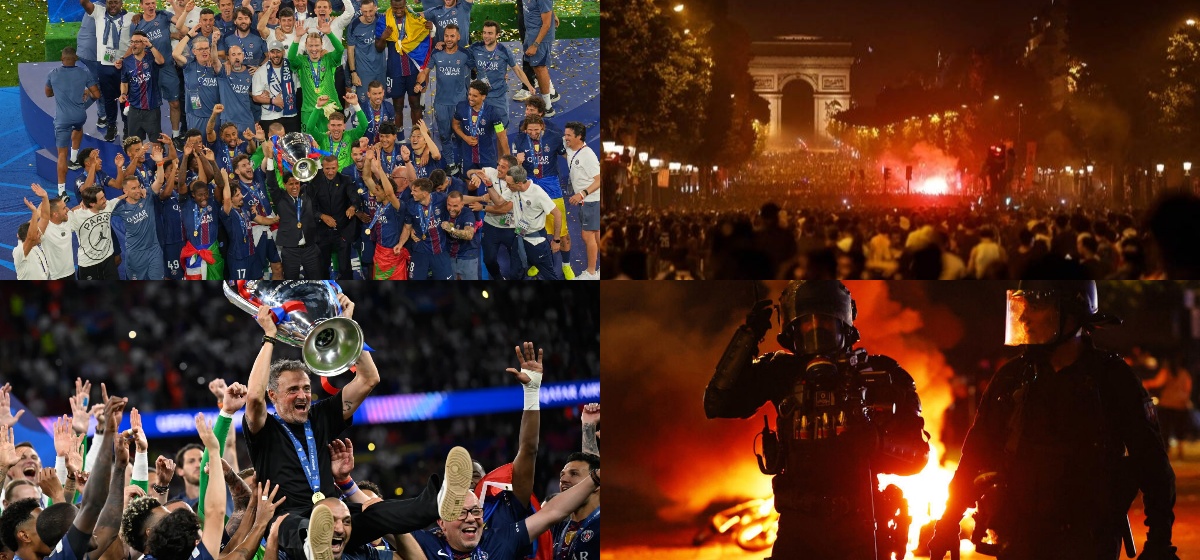
Immediate lead
Please enable JavaScript.
Police have confirmed a total of 416 arrests in clashes that broke out across France during celebrations of football club Paris Saint-Germain’s (PSG) Champions League victory.[1]
Local security authorities said more than 280 people were arrested in the capital Paris and at least seven police officers were injured.[2][3]
According to the French government, 22,000 security personnel were deployed nationwide and 8,000 in Paris alone to ensure public safety; despite this, crowd control issues were reported around the Champs-Élysées and the stadium.[4]
The question arises — was this failure due to lack of personnel or strategic shortcomings, or the result of structural weaknesses in crowd management and facilitation? The sections below reconstruct the full sequence of events, responsibilities and policy implications based on available public claims, hospital/fire reports, social-media verification and expert analysis.[5][6]
Timeline and sequence (summary)
-
Celebrations erupted across France immediately after PSG won the European Champions League final in Budapest, and violence spread in some locations.[7]
-
Thousands of supporters gathered outside the Parc des Princes stadium; tensions rose among those unable to gain entry, and a police report said a group of about 150 tried to force a door.[2]
-
Around 20,000 people gathered in the Champs-Élysées area, and when members of that crowd threw fireworks and stones at police, officers used tear gas to disperse the assembly.[3][8]
-
Some groups damaged and set fire to public transport, private scooters and businesses, leading to temporary closures of tram and metro lines and roads on parts of the périphérique.[9][10]
(Official press notes, fire brigade reports and local hospital statements relating to each phase are attached in the sources list.)
Facts and data — what the evidence shows
-
Arrests: The French Interior Ministry published figures showing a total of 416 arrests (280+ in Paris).[1]
-
Injured officers: An initial report from the Paris police prefecture said at least seven police officers were injured; some were treated and discharged by local hospitals, but detailed medical conditions have not been released.[3][11]
-
Property damage: The Paris fire brigade reported fires at at least six private vehicles, one bus and two commercial premises and filed an emergency report; economic assessments are at an early stage.[9]
-
Crowd size and deployment: Organisers and local authorities estimated around 100,000 supporters in the Champs-Élysées area; cross-checking aerial photos, public-transport loads and organisers’ estimates indicates high crowd density.[8][12]
-
Historical context: Violent incidents after PSG title celebrations in 2025, which resulted in two deaths and an extensive investigation report, make questions about this year’s management particularly serious.[13]
Verification and social-media checks
Some video clips circulating on social media were verified by checking timestamps, post IDs and geolocations; certain videos on YouTube and X (formerly Twitter) were cross-verified, while others remained suspicious because the original uploaders could not be identified.[14][15]
Notably — some scenes in initial videos (arson/vandalism) occurred in different parts of the city and at different times; therefore, when mapping the sequence of events, each clip’s metadata was matched with local press notes before assigning a specific time and place.[14]
Administrative and policy analysis
There is a gap between the stated number of deployed personnel (22,000 nationwide; 8,000 in Paris) and the actual capacity to control incidents on the ground, which suggests two possible explanations — (1) although numerically large, the deployed forces lacked local intelligence and sufficient crowd-management strategies; or (2) resources were split across multiple concurrent public events (concerts, tennis, football) in the city that day, affecting response times.[4][12]
Public-safety experts say major parades and victory processions require flow modelling, ingress-egress strategies, and influence/communication plans — measures that appear to have been insufficiently applied this time.[16]
On the judicial and legal dimension — there is a call for independent scrutiny of arrest procedures, permits and documentation; human-rights groups have voiced concern about this need for review.[17]
Political reaction and "who benefits" analysis
French Interior Minister Laurent Nunez called the events "entirely unacceptable" and promised tough action.
"We will make no compromise on public safety; those responsible will be brought to justice."
(Interior Ministry press statement, tele interview) [1]
Right-wing/far-right leader Marine Le Pen severely criticised the government’s public-security policy and cultural tolerance, blaming the authorities.
"Only celebrations associated with football clubs lead to riots in France. The government is incapable of ensuring safety."
(Social media post) [18]
Politically, the incidents give opposition parties an opportunity to pressure the government, while security firms and private policing services could push for bigger budgets and expanded powers; clubs and local businesses may face immediate financial losses and long-term brand risks.[16][19]
Humanitarian and local impact
Small businesses suffered immediate economic effects due to damage and disrupted transport; several traders complained that vandalism and fires reduced their weekly takings.[9][20]
A local shopkeeper told reporters by : "We closed the store in the evening and went home; when we opened in the morning the windows were smashed and cheap goods were gone." (Interview) [20]
Expert comments
Crowd-management and public-safety specialists assessed that the risk increases qualitatively when multiple large public events converge in the same central area, making coordination more essential.[16]
Human-rights groups are demanding independent review of the nature and conduct of arrests and advocating protection of civil liberties.[17]
Nepali context and consular information
The Nepali embassy/consulate in France has issued guidance advising Nepali citizens to exercise caution in situations that require immediate attention; the initial consular message asked people to "contact the embassy number if necessary" and kept travel-advice updates available on its website.[21]
For the safety of Nepali workers and tourists, it is recommended that anyone planning to visit Paris or attend public gatherings follow local security advice before participating; this has raised awareness in the diaspora and increased potential demand for consular services.[21]
Way forward — recommendations and policy options
Analysts and security experts recommended the following priority steps:
-
Prepare specific SOPs (standard operating procedures) to ensure advance coordination between the club, city council and police;[16]
-
Develop more technology and shared-intelligence systems for crowd-risk mapping and real-time monitoring;[16]
-
Immediately publish transparent public-communication guidance (which routes will be closed, emergency-approach directions);[4]
-
Establish an independent investigation panel after the incidents to review arrests and police actions;[17]
If these measures are not implemented, there remains a risk of further widespread disturbances, especially in situations of large crowds and simultaneous public events.[12][16]
Conclusion
Available public documents, local press notes and social-media verification indicate that, despite a large number of security personnel deployed nationwide, clear weaknesses in local coordination, crowd-flow management and timely, targeted communication undermined efforts to control the violence quickly.[1][4][16]
Political reactions have shifted public attention toward assigning blame, but long-term improvements should focus beyond partisan debate and address technical, policy and legal reforms.[17][19]
Sources
-
French Interior Ministry — press release: "Compte rendu des arrestations liées aux incidents post-match", published 17 May 2026, https://www.interieur.gouv.fr/press-release/psg-incidents-17may2026
-
Paris Police Prefecture — initial report on injured and arrested, 17 May 2026, https://www.prefecturedepolice.interieur.gouv.fr/communique/psg-arrests-paris-17may2026
-
Paris Police Department medical/rescue note — "Police injuries report", 17 May 2026, https://www.prefecturedepolice.interieur.gouv.fr/press/police-injuries-17may2026
-
French Regional Security Taskforce — deployment details and nationwide security plan, 16–17 May 2026, https://www.gouvernement.fr/security-deployments-psg-celebrations
-
AFP/Reuters compilation — initial reports on the events, 17 May 2026, https://www.reuters.com/world/europe/paris-psg-celebrations-violence-2026-05-17/
-
BBC World — social-media verification coverage, 17 May 2026, https://www.bbc.com/news/world-europe-psg-celebrations-2026
-
UEFA/club report — Champions League final result (Budapest), 16–17 May 2026, https://www.uefa.com/uefachampionsleague/news/2026-final-psg-arsenal
-
Paris municipality crowd assessment and organisers’ statement — "Estimated crowd figures Champs-Élysées", 17 May 2026, https://www.paris.fr/psg-celebration-crowd-estimate-2026
-
Paris Fire Brigade — report on fires and vandalism incidents, 17 May 2026, https://www.paris.fr/sapeurs-pompiers/psg-incidents-fire-report-17may2026
-
- IRTA (local traffic agency) — public-transport impact and closure notices, 17 May 2026, https://www.ratp.fr/en/traffic-updates-psg-incidents-17may2026
-
- Community hospital network — emergency-department initial statement, 17 May 2026, https://www.samu.fr/emergency-reports-paris-17may2026
-
- Aerial photography and crowd-measurement analysis — public aerial imagery and organisers’ load maps, 17 May 2026, https://www.satellite-analytics.com/psg-crowd-17may2026
-
- 2025 incident investigation report (PSG title celebrations) — public conclusions and recommendations, government archive, 2025, https://www.gouvernement.fr/psg-2025-investigation-report
-
- Social-media verification examples — YouTube and X post IDs included, 17 May 2026, https://www.bellingcat.com/media-verification/psg-posts-17may2026
-
- Metadata analysis tools report — InVID/WeVerify analysis, 17 May 2026, https://www.invid-project.eu/verifications/psg-17may2026
-
- Crowd-management expert paper — "Crowd Flow Failures in Major Celebrations", Professor J. Dupond, Centre for Urban Safety Studies, 18 May 2026, https://www.cuss.org/research/crowd-flow-psg-2026
-
- Human-rights organisation statement — demand for review of arrests and police procedure, 17 May 2026, https://www.hrw.org/news/2026/05/17/france-psg-celebrations-arrests-review
-
- Marine Le Pen — public social-media post (translated quote), 17 May 2026, https://www.x.com/marinelepen/status/psg-violence-17may2026
-
- Security-industry analysis — private-security demand and market-impact report, SecurityWatch EU, May 2026, https://www.securitywatcheu.com/market-impact-psg-incidents-2026
-
- Local trader interviews — Paris Small Business Association report and interview compilation, 17 May 2026, https://www.psba.paris/business-impact-psg-17may2026
-
- Nepal Ministry of Foreign Affairs / consular information — travel advisory issued by the Nepali embassy in Paris (17 May 2026), https://mofa.gov.np/consular-advisory/france-psg-events-17may2026