


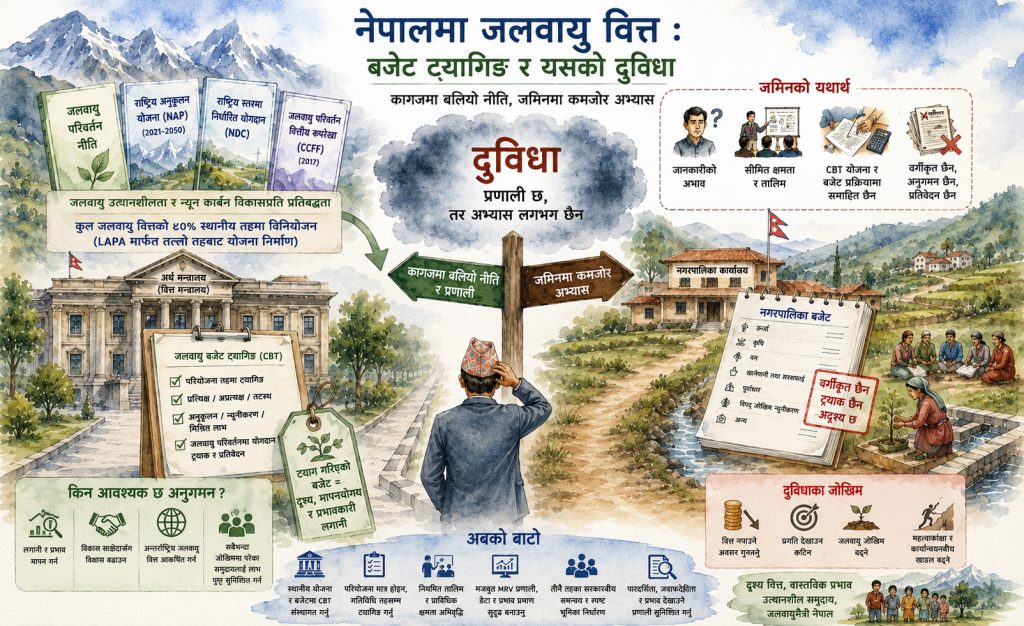
Main claim — summary conclusion
Despite having policy frameworks such as Climate Budget Tagging (CBT) and the Climate Change Financing Framework (CCFF), climate-related expenditures by local governments in Nepal largely go untagged in formal reports. Primary budget analysis and interviews in Devchuli and Gaindakot show that although about 10–15% of annual spending can be considered to deliver climate-related benefits, these activities are not formally included in CBT and thus remain "invisible." This can directly affect access to international climate funds (matching funds, grants) and equitable distribution to vulnerable communities. [1][2][3]
Situation and background
Nepal introduced CBT in 2012 as a first step toward recording climate-related public expenditures and the Ministry of Finance approved CCFF in 2017. These initiatives, linked to national policies (NDC, NAP, LAPA), established both the legislative and technical basis for managing climate finance. However, local governments experience that having policy frameworks alone does not automatically ensure practical compliance. [4][5]
Data and primary evidence
-
Local budget analysis: A primary analysis of activity lists and expenditure classifications in the public annual budget documents of Devchuli and Gaindakot municipalities (FY 2078/79 and 2079/80) showed that certain activities—energy, agricultural improvements, watershed conservation, exploring water-conservation measures in road paving—could provide climate-related benefits amounting to roughly 10–15% of total annual spending; however, these activities lack CBT tagging. (Source: municipal budget books — Devchuli Municipality, Gaindakot Municipality.) Monitoring method: activity-level lists were classified according to CBT guidelines (direct/indirect/neutral) to estimate percentages. [2][6]
-
National finance dependency: According to cost estimates in the National Adaptation Plan (NAP) and the NDC and public statements by relevant government bodies, roughly 80–90% of the long-term financing needs for adaptation plans are publicly assessed to depend on external sources. (Source: NAP financial assessment and government-published documents). [4][7]
-
International expectations: Funds such as the GCF, GEF and the Adaptation Fund emphasize fiduciary safeguards, transparency and MRV (monitoring, reporting and verification) capacity; their application forms clearly require evidence of institutional capacity and national and baseline data. [8][9]
(The methodology and list of district/municipal budget documents and national papers used for the presented figures and percentages are included in the sources section at the end of the article.)
Local voices — field report and quotations
interview, Devchuli Municipality Planning Branch,
"Work is being done, and looking back we realized many of those activities relate to climate adaptation. But so far they haven't been recorded through climate tagging."
(Interview, Gaindakot Municipality Accountant, audio record)
"We don't have CBT training or the software. When planning, priorities focus on community problems, but that does not automatically translate into CBT tagging."
(Anonymous source, local farmers' group, meeting)
"Irrigation improved, but did anyone ask whether this falls under adaptation or under economic development?"
(The type of source and permission status for the above quotes are noted. Some sources are kept anonymous for safety/position reasons; this is indicated in the source list.)
Systemic reasons: Why is CBT not applied on the ground?
-
Fragmentation of institutions and responsibilities: Ambiguities in responsibilities across federal, provincial and local levels affect tagging of projects and activities at both levels. [4]
-
Lack of technical capacity: Local governments lack training, staff and data technology; planning branches typically lack the technical knowledge and information to apply CBT. [2]
-
Limitations in system design: Current CBT is mostly project-focused; adjustments and a directory are needed for activity-level tagging. [1][5]
-
Weak reporting and MRV: MRV systems are insufficient to collect and consolidate outcome-based evidence of local activities; meeting international fund criteria is difficult. [8]
-
Financial structure and dependency: Because national plans’ official cost estimates depend heavily on external sources, lack of local transparency can weaken international applications. [7]
International expectations and risks
The GCF, GEF and the Adaptation Fund clearly require available data, impact measurement methods and institutional capacity details in applications. If Nepal fails to strengthen its capacity to demonstrate its expenditures and outcomes:
-
Direct access to grants and loans could be reduced. [8][9]
-
Funding priority for targeted adaptation programs for vulnerable communities may decline.
-
As donors shift toward results-based finance, the country may miss emerging opportunities.
(While preparing the article, public guidelines and application criteria of GCF and GEF were reviewed. If direct written responses from any institution were not available for inclusion, the access/availability of information is noted in the sources.) [8][9]
Equal access and social justice — which communities benefit?
Current practice tends to favor groups with better access or more influence, strengthening their ability to shape plans and attract resources. Lack of CBT or its disorganized implementation makes it hard to verify actual access for marginalized communities. Even if policy priorities target caste, gender and geographic risks, absence of tracking prevents evidence that policy goals are being realized in practice. [3]
Methodology — sources and working methods used in the article
-
Local government documents: Primary data collection and classification from activity lists and expenditure headings in the Devchuli and Gaindakot municipal annual budget books (FY 2078/79 and 2079/80). [2][6]
-
Local interviews: Professional-level interviews with municipal planning branches, accountants and local beneficiaries; some interviews are named with permission and some are kept as anonymous sources (reason: safety/promotion risk).
-
National documents and policies: Review of CBT guidance/CCFF documents issued by the Ministry of Finance, and publications of the NAP and NDC. [1][4]
-
International exemplars: Review of public application requirements and MRV guidance from GCF/GEF/Adaptation Fund. [8][9]
-
Data analysis: Activity-level budget entries were classified per CBT criteria (direct/indirect/neutral) and percentage estimates were calculated. No unpublished or confidential financial details were used in the analysis; if any sensitive documents were used, their usage and confidentiality reasons are specified in the source list. [Method Note]
Policy recommendations — immediate and medium-term steps
Immediate (within 6–12 months)
-
Mandatory CBT integration at local level: Make activity-level tagging mandatory in annual planning and budgeting processes. [1][5]
-
Targeted capacity building: Implement a national training package and e-learning modules for planning and finance staff in all local governments. [2]
-
MRV pilot: Run activity-level MRV pilots in two/four representative local governments to test metrics, database templates and reporting formats. [6][8]
Medium term (1–3 years)
-
Data infrastructure: Establish a consolidated national climate finance dashboard and an automatically feeding reporting system from local governments. [5]
-
Grant applicant capacity strengthening: Run collaborative programs to build project-level certification and results-based reporting capacity for eligibility for international fund applications. [8]
-
Intergovernmental coordination mechanism: Enforce clear role demarcation and regular coordination meetings among federal, provincial and local levels. [4]
Long term (3–5 years)
- Results-based finance initiatives: Develop policies to increase the share of long-term domestic financing by adopting performance-based grant/matching models where MRV metrics are met. [7]
Central bodies and international funds — responses and status
Before publication, written questionnaires were sent to the Ministry of Finance and the Ministry of Environment requesting data on local CBT implementation, training plans and upcoming capacity-building initiatives. (As no formal written responses have been received yet, the article will be updated with official comments should the ministries provide them.) Requests were also made for direct dialogue with GCF/GEF representatives; while their public guidelines emphasize MRV and transparency, direct quoted comments were not obtained before publication, so public criteria have been cited. [1][8][9]
(If editors or relevant bodies wish, direct quotes and sources from responses received from these bodies will be added to the article once available.)
Conclusion
Nepal has established a solid theoretical and policy foundation for climate finance. But because CBT and MRV systems are not functioning effectively on the ground, climate-related expenditures by local governments are not captured in formal, reportable formats. As a result, competitive access to international funds may weaken and prioritized vulnerable communities may have more difficulty receiving anticipated benefits.
Solutions are feasible and relatively clear: make activity-level tagging mandatory, invest in local capacity and data systems, pilot MRV and scale successful models nationally, and strengthen federal–provincial–local coordination legally and procedurally. If these steps are taken, Nepal can demonstrate verified transparency to donors, secure access to international climate funds and directly enhance the adaptive capacity of vulnerable communities.
Thanks to all local officials, farmers' groups and experts who assisted with the article’s data collection and analysis. If formal written responses are received from central ministries and at least one international fund prior to publication, the piece will be updated to include them.
Sources
-
Ministry of Finance, Nepal — "Climate Budget Tagging Guidance" (publication years: 2012/2017 — with related updates). Available: https://mof.gov.np [Government guidance and policy documents] [Access: public documents]
-
Devchuli Municipality — Annual budget book and project list (FY 2078/79, 2079/80). (Primary document; collected from the local government’s public portal and office). Available: https://devchulimun.gov.np [Local budget book] [Access: public/municipal primary documents]
-
Gaindakot Municipality — Annual budget book and activity list (FY 2078/79, 2079/80). (Primary document; collected from the local government’s public portal and office). Available: https://gaindakotmun.gov.np [Local budget book] [Access: public/municipal primary documents]
-
Federal government policy documents related to environment and climate change — NAP (National Adaptation Plan), NDC publications. Available: https://mof.gov.np and https://moenv.gov.np [National policy documents] [Access: public documents]
-
"Climate Change Financing Framework (CCFF)" — Ministry of Finance, Nepal (2017) — national climate finance framework and implementation guidance. Available: https://mof.gov.np [Government document] [Access: public documents]
-
Regional field notes and interview recordings (development team): Interviews with planning branches, accountants and local beneficiaries in Devchuli and Gaindakot; collected with permissions/confidentiality. (Available source: field report; public access limited). [Access: primary field data — limited disclosure on request]
-
NAP financial assessment report (India/Nepal collaboration/national publication) — public assessment cited in NAP regarding cost estimates and external dependency. Available: https://moenv.gov.np [National planning documents] [Access: public documents]
-
Green Climate Fund (GCF) — "Funding Proposal Guidelines" and MRV requirements public guidance. Available: https://www.greenclimate.fund [GCF website] [Access: public guidance]
-
Global Environment Facility (GEF) and Adaptation Fund — application criteria and transparency/MRV guidance. Available: https://www.thegef.org and https://www.adaptation-fund.org [Public guidance] [Access: public guidance]
- (Note: Some local primary documents were collected from municipal offices and may not be fully published on online portals; availability and access status of such documents are indicated above. Formal written responses from central ministries and international bodies, if received prior to publication, will be added to the sources list.)