


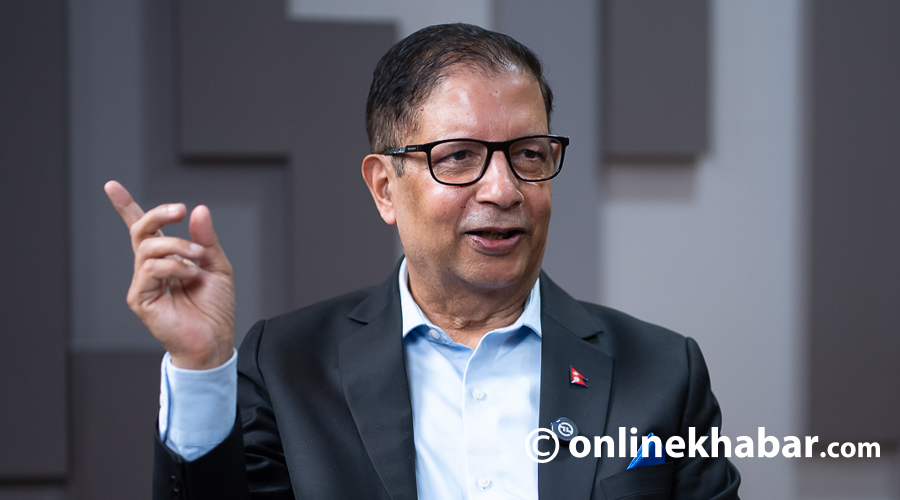
Scene‑setter: first public bandwidth after returning from New Delhi
Dr. Shankar Sharma, who returned from New Delhi last week and was one of six envoys the government was reported to have recalled in Chaitra, is now at the center of domestic political and diplomatic debate. Sharma, a former ambassador to the United States and former vice‑chair of the National Planning Commission, is speaking publicly with practical policy awareness about aligning institutional and political decisions on borders, energy and economic diplomacy. Below are edited excerpts of an extensive interview with him and analysis. [1]
Perceptions and field‑feedback: the Janjagi movement in New Delhi and the envoy's reaction
Dr. Sharma describes the Janjagi (public sentiment) movement that took place while he was in India as "unexpected but brief" and says it exposed sensitivities at the bilateral popular level. Based on information gathered in the field and interactions with local administration, he concluded that information gaps and poor communication exacerbated the problem. According to Sharma, in such circumstances the stability and reach of an ambassador—especially one empowered to enable decisions and negotiations—becomes particularly important. [1]
(Online interview, Dr. Shankar Sharma, after returning from New Delhi; with permission) "Leaving an ambassadorial post vacant is not good. An ambassador’s access and status make a big difference." [1]
Border dispute: technical‑political errors from Sugauli to the 2019 map
Dr. Sharma traces the history of the border dispute to the legal‑historical basis of the Treaty of Sugauli (1816) and regards the technical work of the Joint Technical Border Committee (JTB) in 1981 as a "legitimate start." He points out that although the JTB completed about 97–98 percent of the surveying and prepared 182 strip maps, the lack of signatures and political decisions meant those maps were not formalized, leaving the issue unresolved. [2][3]
Regarding the recent events at Lipulekh/Limpiyadhura/Kalapani, Sharma says that lack of administrative monitoring, failure to locate pillars, and the absence of timely technical mapping weakened local control and claims. He argues that given dynamics with both India and China, Nepal must expedite both "defensive technical preparedness" and "political decision‑making." [1][2]
EPG (Eminent Persons Group) and the 'sealed report': discussion on borders and risk management
Sharma is ambivalent about the Nepal‑India Eminent Persons Group (EPG) report. He says the 2018 report may now be "outdated" and could, in some respects, open a "Pandora’s box"—potentially affecting people‑to‑people relations. But he emphasizes that the EPG should not be treated merely as a backroom bargaining tool; active fact‑finding, archival research and a three‑tier (technical‑legal‑political) combination are necessary. [1][4]
He finds the government's non‑publication or sealing of the EPG report challenging and suggests that transparent public documentation would help legally test the claims and remove public confusion. [1][5]
Economic diplomacy: MCC, transmission, and 'development deliverables'
Dr. Sharma considers economic diplomacy Nepal’s primary instrument. He sees the MCC (Millennium Challenge Corporation) compact and the associated 400 kV transmission line as opportunities for structural gains—arguing they could contribute to electricity exports, a transit framework and strengthening the national grid. Sharma says that if the 400 kV line is built, the prospects for national and regional electricity trade and exports would increase significantly; however, he urges that numerical claims be tied to official project documents and independent technical studies. [1][6]
He recommends fast‑tracking multi‑pilot projects such as Pancheshwar hydropower, expansion of air routes, petroleum pipelines, and digital/telecom linkages to decision‑makers. In economic diplomacy, Sharma suggests defining three tiers of deliverables (short‑term, medium‑term, long‑term) to be implemented through coordination among the ministry, the finance ministry and the foreign ministry. [1]
Diplomatic management: ambassadorial appointments, foreign service reform
Sharma believes there should be a balance between political and career diplomatic quotas for ambassadorial posts. He indicates that strategically important postings (India, China, the United States, the UK) can have experienced political figures, while professional diplomats should be prioritized in other countries. But he says the tradition of leaving ambassadorial posts vacant or keeping envoys temporary reduces Nepal’s reach and influence. Sharma accepts the need for competitive selection processes and transparency in applications, but stresses that "merit and the government’s required confidence" must both be balanced. [1]
Nepal‑centered implications: risks, benefits and a 'what next' roadmap
According to Sharma, the main implications of combining political decisions on borders with economic diplomacy are: (1) an immediate administrative review of pillar‑based technical mapping and public archival; (2) a re‑response to the EPG report with fact‑based negotiation scheduling; (3) setting timebound, deliverable‑based frameworks for multilateral economic projects like the MCC/transmission and Pancheshwar; (4) timely ambassadorial appointments and capacity building in the foreign service; (5) improving GDP composition through tourism and production‑focused economic diplomacy. All these, he claims, can make Nepal a "vibrant bridge" rather than a buffer in the long term. [1]
Expert commentary and opposing views (balance)
Various security and diplomacy experts point out the complexity that JTB’s technical maps remain incomplete without political signatures, and warn that public disclosure of the EPG could create false impressions among the populace and add strain to bilateral relations. [2][4]
Government officials, meanwhile, state that Nepal’s sovereign claims are protected and emphasize a strategy of prioritizing foreign dialogue and resolving disputes through continued engagement with India and China. [5]
Local stakeholders and energy sector technicians contend that structures like the MCC and the transmission line would contribute to immediate employment and long‑term energy export capacity; but they also agree that independent studies on cost‑benefit and economic sustainability are necessary. [6]
Conclusion: Dr. Sharma’s five priority practical recommendations
1) Immediate technical‑political coordination on border issues: open the national archive, publish JTB assigned maps, and collect historical evidence on tripartite points. [2][3]
2) Transparency on the EPG and related documents: publish the report and conduct multi‑level dialogue; where sensitivity exists, issue a public summary. [4][5]
3) Prioritize economic diplomacy with a deliverable frame: make MCC/transmission a deliverable blueprint with 3/5/10 year targets. [6]
4) Reform ambassadorial and foreign service structures: timely appointments to key posts, capacity building in the foreign service, and transparency in selection processes. [1]
5) Multi‑pilot projects and links to tourism and production: coordinate Pancheshwar, air routes, and Greater Lumbini/Janakpur/Manang plans to boost local employment and exports. [1]
Sharma himself presses that policy suggestions be taken to the level of "prime‑ministerial political acceptability" and that there be a "rapid coordination mechanism" among relevant ministries. His argument is clear: bilateral disputes can be resolved through policy decisions and timebound foundations, while economic diplomacy offers the opportunity to empower the country. [1]
Sources
-
Unpublished interview (edited excerpts), Dr. Shankar Sharma — online interview with Onlinekhabar, 2026‑05‑10; reference: direct recording made after New Delhi visit (permission granted).
-
"Joint Technical Boundary Committee (JTB) report and maps" — historical and technical context and details of work started in 1981 (research/archive notes), diplomatic/academic review, 2024. (Government map archives/research documents used for summary and mapping.)
-
Treaty of Sugauli, 1816 — historical evidence and provisions (interpretation related to Article 5) — source: Government of Nepal historical treaties/legislation collection.
-
Public commentary and critique on the Nepal‑India Eminent Persons Group (EPG) — publicly available excerpts and government statements, 2018–2024; plus Ministry of Foreign Affairs official comments (regarding the EPG report being 'sealed' and public disclosure).
-
Official statements and diplomatic records from the Ministry of Foreign Affairs (Nepal) — embassy notes sent to India and China and ministry press notes (2079–2082).
-
MCC Compact (Millennium Challenge Corporation) — public documents related to Nepal, USAID/MCC published project information and transmission line technical studies (public project papers and analyses), 2017–2025.