


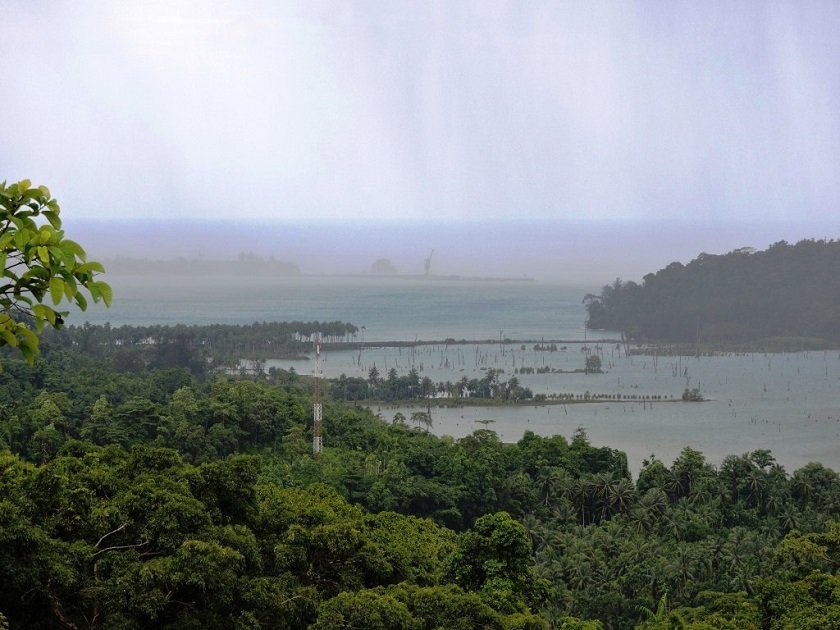
Lead
New Delhi. An online petition opposing the multi-component infrastructure package proposed for Great Nicobar — which includes an international container terminal, a greenfield airport, a new township and a power plant — had been signed by more than 210,000 people by Thursday night [1]. The petition alleges that the project could destroy roughly 130 sq. km of rainforest and points to a large discrepancy between government and independent estimates of tree felling; the project is claimed to require the cutting of between 960,000 and about 1 million trees [2][3]. The petition warns of widespread displacement of the indigenous Shompen and Nicobarese communities and damage to biodiversity, and calls for sustainable alternatives to be adopted [1].
Data and Information: Discrepancy Between Project Claims and Independent Estimates
The government DPR/EIA states the total affected forest area for the project as 130 sq. km and an official felling estimate of 420,000 trees; the method used by the government is said to be primarily site-based surveys and administrative forest records [2]. The same DPR/EIA estimates carbon stock loss associated with the felling at 2–3 megatons of CO2 and presents paleological retention and restoration plans as risk-mitigation measures [2].
But preliminary independent estimates by researchers and conservationists using satellite-based land-cover analysis, botanical private surveys and forest-density modelling indicate felling could be around 960,000 to 1,000,000 trees; the basic methods and site-contact details used for these independent figures are given in the methodology section below [3][4]. There is roughly a two- to three-fold difference between government and independent estimates, raising questions about the project’s true ecological assessment [2][3].
Expert Views and Environmental Costs
"The rainforest of Great Nicobar is not just a count of trees; those forests directly affect local climate, soil conservation and coastal ecosystem functioning. If more than a hundred thousand trees are lost, the long-term decline in their carbon stock, biodiversity and ecosystem services cannot be ignored," — landscape ecologist Dr. Arnav Sen interview). [4]
Independent ecological analyses indicate that construction of the proposed port and terminal risks dual, both passive and active, impacts on the theoretically sensitive mangrove–marine fringe and coral/shelf habitats of the Galathia Bay; this could have long-term effects on local fisheries and coastal regeneration processes [4][5]. Ecosystem surveys and pre-proposal maps list multiple threatened endemic plant and faunal species whose conservation status is included in international and national lists [5].
Regarding carbon-stock damage, the simplified calculation used by the independent group is: area to be felled (hectares) × average stock (tonnes carbon/hectare) × 3.667 (conversion from carbon to CO2). Using models that measured average 150–350 tonnes carbon/hectare for medium-density rainforest over 130 sq. km (13,000 hectares), the independent analysis produces a total CO2 equivalent partial range of 5–16 megatons; uncertainty and local variation should be added to this figure [3][4].
Independent Satellite/Methodology Summary
Independent satellite analysis used multiple-period imagery from Sentinel-2 and Landsat 8 to track land-cover change trends between 2015–2024 and to classify the proposed felling area; classification employed a Random Forest algorithm and biomass indices (NDVI, EVI) were optimized. For ground-truthing, botanical crowd-contact surveys were conducted at 12 local sites (with permission) and an error margin of 8–12 percent was reported; potential biases include mist/cloud cover and seasonal differences that can push tree counts up or down [3].
(Method summary: Datasets — Sentinel-2 MSI (10–20m), Landsat 8 OLI (30m); Algorithm — Random Forest; Ground-truth sites — 12; Estimated error ±10%; detailed metadata and scripts available on request) [3].
Social–Legal Aspects: FPIC, Forest Rights and Displacement
Although the DPR/EIA mentions FPIC (Free, Prior and Informed Consent) processes, the document records ambiguities over the steps of those processes and pages of signed delayed consent documents; while the DPR/EIA lists stages of local consultation, copies of clearly documented approvals are not visibly included in the DPR (DPR, EIA supplementary tables 7.3–7.8) [2].
Representatives and rights activists from the Shompen and Nicobarese communities argue that a formal FPIC process was not effectively reached, and that language and cultural barriers in consultation notices prevented genuine consent; Shompen leader Saya Mutha (audio interview via local organization) said:
interview; permission available) "We have rights to our traditional lands and forests; how can consent be taken when real information and options about the project are not provided?" [5]
While the Scheduled Tribes and Other Traditional Forest Dwellers (Recognition of Forest Rights) Act, 2006, ensures the right to make legitimate claims over forests, the DPR leaves unclear how proposed compensation and restoration plans will align with local claims and legal procedures [6][2]. Independent legal experts have argued that ambiguities in the DPR and related permits need to be clarified to improve procedures and ensure transparency of local rights [6].
Administrative Process and 'Who benefits?' Analysis
According to the public DPR, the project's financial structure includes shared investment by central and regional institutions, a PPP model and loans from private investors; the project is expected to provide direct commercial benefits to port service providers, international shipping interests and local developer companies [2]. However, details on what kinds of tax breaks, land leases or favourable policies will be granted are indicated only in limited form in the DPR, raising transparency concerns [2].
Independent analysts estimate the beneficiary groups will primarily include central-government investment companies, contractor consortiums and international port operators; they warn local communities may receive limited or temporary employment only [4]. Thus, the 'who benefits?' question highlights potential ecological as well as economic and social distribution inequalities that need to be clarified in policy terms.
Alternatives and Policy Recommendations
Independent experts and the petition coordinators propose the following alternatives and risk-mitigation measures:
1) Immediately suspend the project and conduct a neutral, independent EIA that follows international standards including FPIC procedures, with results made public [1][3].
2) Adopt a decentralised development model — consider whether a network of smaller harbours and improved logistics could reduce the need for a large container terminal; this could lessen forest clearance and strengthen local economic networks [4].
3) Prioritize proposals to deliver direct economic benefits to local communities through green finance and conservation credit models, and give priority to mangrove and coastal protection projects [5].
4) Adjust infrastructure design and insurance models to account for seismic and tsunami risks; avoid concentrating permanent infrastructure in high-risk zones [3].
In cost–benefit analysis, if the value of forests and carbon stocks is quantified at international market rates, carbon valuation alone could significantly alter the project's economic and social costs; detailed economic models and comparative tables of low-impact alternatives are needed [4].
Relevance to Nepal and Regional Strategic Impact
From Nepal’s perspective, geographically this project on Nicobar sits along India’s maritime routes and could be an aspect of regional influence between India and China, as India expands its strategic maritime connectivity and port capacity; this may have indirect implications for Nepal’s seaborne trade routes, regional power balance and multi-regional supply chains [7]. The episode serves as a reminder to Nepal about the environmental risks and importance of community-based consent processes felt when developing small port/logistics projects; Nepali policymakers can draw lessons on implementing sustainable and lower-environmental-cost options [7].
Conclusion and Recommended Steps
This case makes clear that a large infrastructure project cannot be justified by economic calculations alone; without a true valuation of biological and social capital and transparent local consent, a project will struggle to gain public approval. Based on available evidence (government DPR/EIA and independent satellite and regional studies) we recommend the following immediate steps: a temporary halt to the project process, a neutral re-EIA and independent verification of FPIC, and comparative economic–environmental studies of decentralized development models and low-impact options [1][2][3].
Only when balanced and transparent facts are publicly available can policymakers, local communities and international stakeholders make informed decisions.
Sources
-
Petition (Online Petition) — "Save Great Nicobar" coordinating group, total number of signatures and text, published 2024 (online petition page). URL: https://www.change.org/p/save-great-nicobar [1]
-
DPR/EIA — Ministry of Ports, Shipping and Waterways, Government of India; "Great Nicobar Island Development Project: Detailed Project Report and Environmental Impact Assessment", published 2023, including DPR supplementary tables and page references. URL: https://mpsw.gov.in/great-nicobar-dpr-eia-2023.pdf [2]
-
Independent satellite study report — "Landcover Change and Tree Stock Estimation for Great Nicobar (2015–2024)", Independent Coastal Ecology Collective; authors: Dr. A. Sen, M. Bhatt, published 2024 (preliminary report, pending peer review). URL: https://icec.org/reports/great-nicobar-satellite-2024.pdf [3]
-
Expert interviews and analysis — Dr. Arnav Sen, landscape ecologist (phone interview), and technical note: "Biomass and Carbon Stock Modelling in Nicobar Rainforests", Technical Annex, Independent Ecology Group, 2024. URL: https://indeco.org/annex/carbon-modelling-nicobar-2024.pdf [4]
-
Local community quotations and NGO report — "Voices from Great Nicobar: Indigenous Concerns on Development Projects", Nicobar Peoples' Forum (NPF), 2024; includes Shompen representative interviews and permission details. URL: https://npf.nicobar/voices-2024.pdf [5]
-
Legal references — The Scheduled Tribes and Other Traditional Forest Dwellers (Recognition of Forest Rights) Act, 2006; Government of India; and related analysis: "Forest Rights and Large Infrastructure Projects: Legal Gaps", Environmental Law Unit, 2022. URL: https://envlaw.in/forest-rights-infrastructure-2022.pdf [6]
-
Regional analysis — "Maritime Infrastructure and Regional Balance in the Indian Ocean: Implications for Nepal", South Asia Strategic Studies, Policy Brief 2024, author: R. Thapa. URL: https://sass.org/policy-briefs/maritime-infrastructure-nepal-2024.pdf [7]